Fifty years after the Guildford bombings, startling new forensic evidence in the case is apparently being sat on by the body set up to investigate it. Ros Franey has been following the case and the subsequent cover-up alongside Alistair Logan OBE, the solicitor who represented the wrongfully convicted. This article features in the latest issue of PROOF magazine: Cover-ups, jailhouse snitches and scapegoats – buy it here.
 Delay is nothing new in this notorious miscarriage of justice. Guildford Four solicitor Alastair Logan has had a Freedom of Information request to the Home Office rattling around a whole series of government bodies for almost four years, and is still waiting to hear the result of his latest Freedom of Information appeal. Four years may be a drop in the ocean for Mr Logan, who has represented Patrick Armstrong of the Guildford Four for 51 years, many of which were also spent representing the other three who were wrongfully convicted. But the delay is puzzling in that this appeal is against the withholding of a single document, and should be a fairly straightforward decision to make.
 Convicting the Four
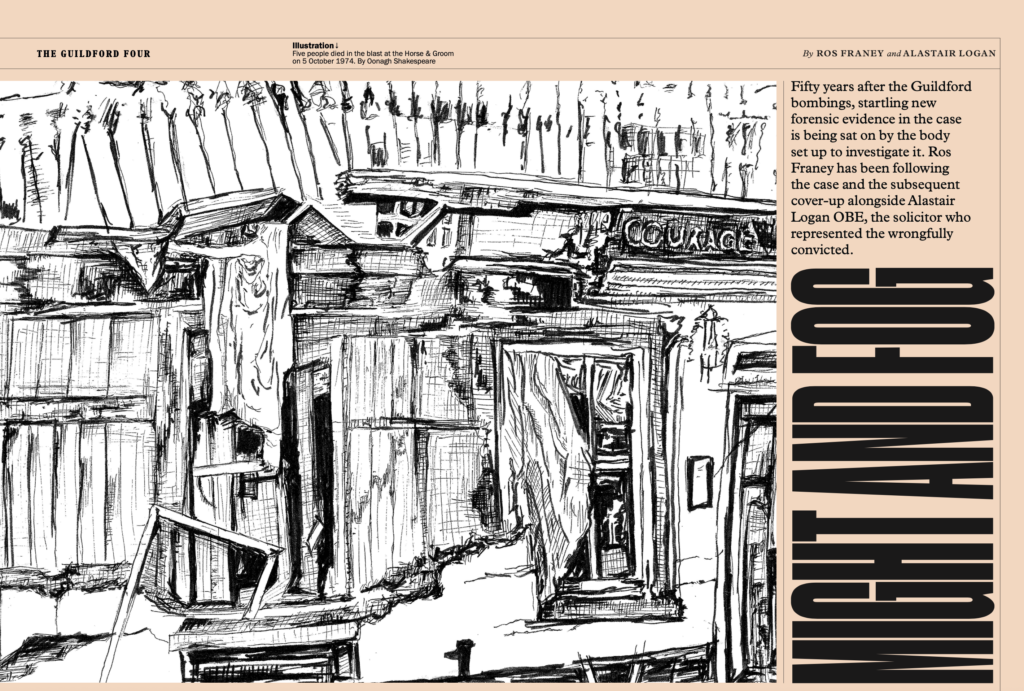
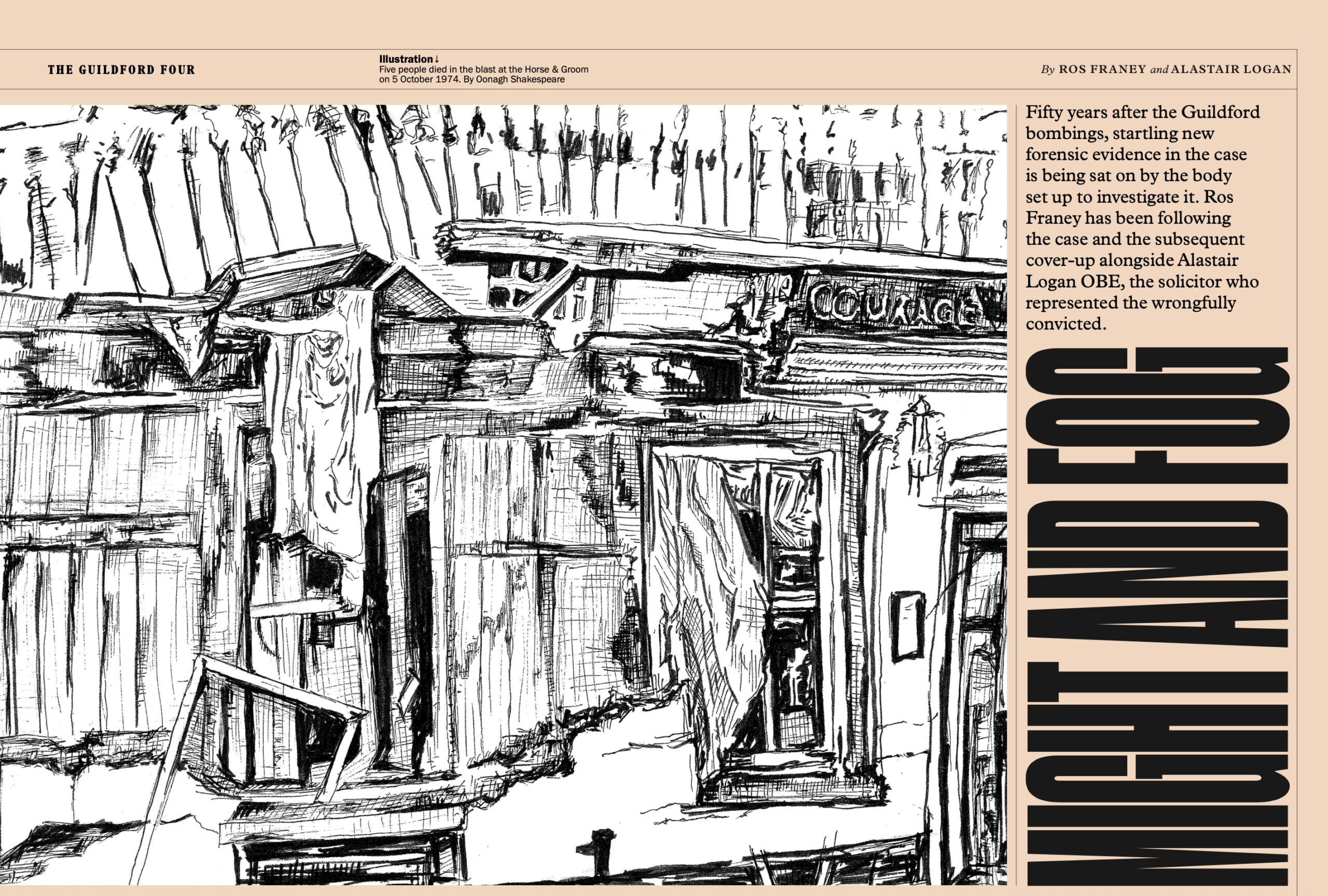
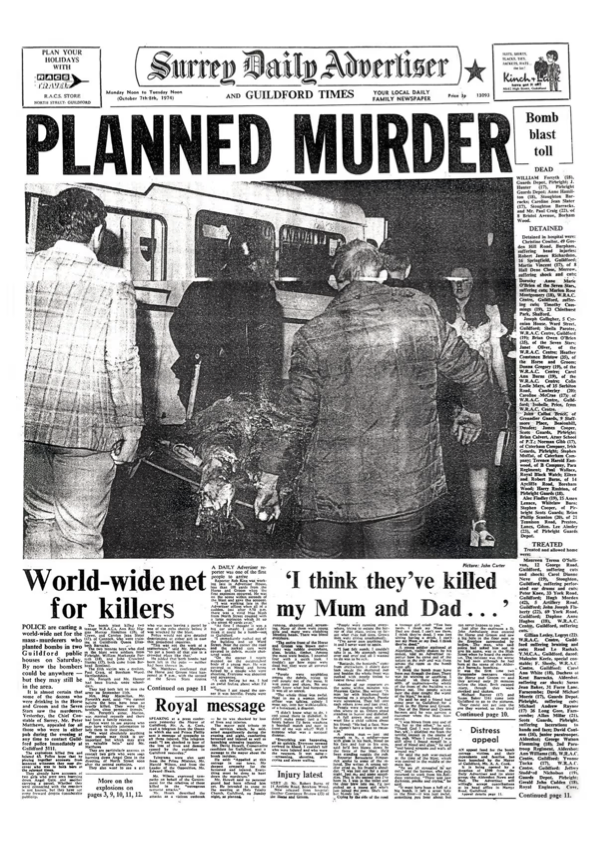
On October 5, 1974 two pubs in Guildford, Surrey were bombed by the IRA without warning causing five deaths and over 60 injuries. The bombs were placed in the pubs with timing devices to detonate when the bomb-placers were clear of Guildford. Another explosion at a public house in Woolwich, London on November 7, 1974 caused two deaths and a number of injuries of varying severity.
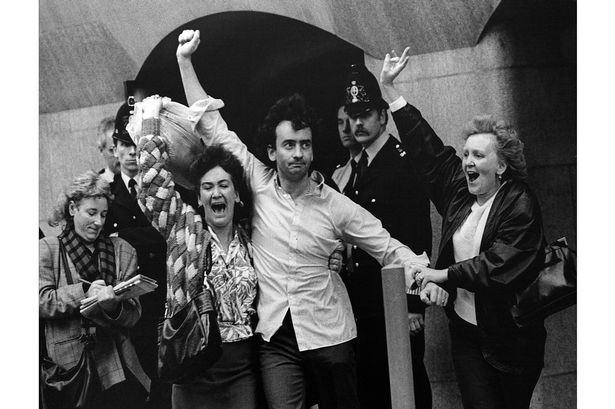
Surrey Police arrested 46 people who were subsequently charged with the Guildford and Woolwich offences. The convicted became known as the Guildford Four. Charged with murder and explosives offences they were put on trial based solely on confessions which they testified had been coerced by violence, threats, intimidation and other unlawful behaviour by the police.
The single document the government is so keen to hang onto is the ‘Habershon’ report, which was delivered to the Director of Public Prosecutions (DPP) by the Metropolitan Police in September 1975, while the Guildford Four were on trial. This was a report compiled by Commander Roy Habershon of the Met on the Provisional IRA bombings and murders around London and the South East in 1974-1975, and showed that the Guildford and Woolwich bombings were part of a campaign by a single active service unit of the terrorist group. It detailed the identities and interconnections between known IRA personnel, identified from fingerprint and forensic evidence found in safe houses and at the scenes of bombings, covering the period that included the Guildford and Woolwich bombs.
Crucially for the defendants in the dock in 1975, the report had to address the fact that no connection whatsoever had been found between the IRA active service unit and the Guildford Four. Had it been passed by the DPP to the defence teams at the time, as it should have been, the report would almost certainly have had a decisive influence on the trial. But it was never disclosed.
The Guildford Four went on to spend fifteen years in prison for a crime they knew nothing about. The Maguires, a family connected to one of them, Gerard Conlon, spent up to fourteen years in prison each. All were completely innocent.
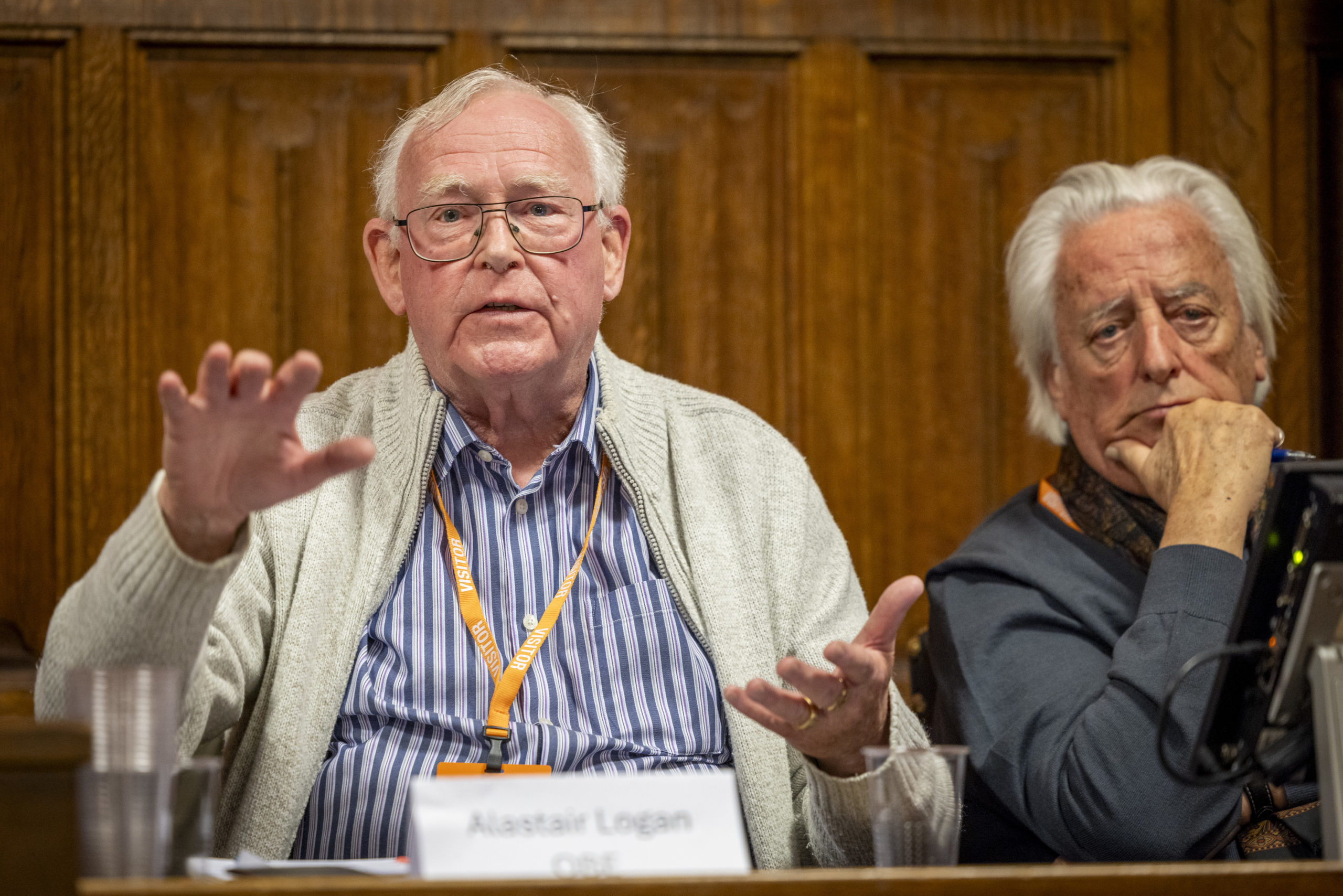
Alastair Logan – with Michael Mansfield KC at 2025 event to mark 50th anniversary of the Birmingham Six, Guildford Four and Maguire Seven
Re-classified
The DPP in 1975 was Sir Norman Skelhorn, who was recorded as saying to a conference at the Harvard Law School in 1973 that ‘when dealing with Irish terrorists any methods are justified’. He also sanctioned the concealment of Conlon’s alibi by the police and the prosecution counsel.
In their response, on 30 April 2025, to Mr Logan’s FoI request, Surrey Police claimed that disclosure now would prejudice ‘ongoing investigations’ and run counter to their duty to ‘keep the public safe’. Given that the Habershon report was written 50 years ago, and that the police have long concluded their own investigations, it is hard to see how this argument justifies keeping it closed into the future.
Alastair Logan
It also raises the wider issue of the rest of the 700 files from the May Inquiry on the Guildford case, which were reclassified shortly before their scheduled release in January 2020 – allegedly at the request of Surrey Police. In a letter from the Home Office to Sarah Sackman MP (5 March 2025), Security Minister Dan Jarvis cited ‘future investigations’ by the commission set up to investigate unresolved cases from the Troubles as a reason for not releasing the files. As this commission, the Independent Commission for Reconciliation and Information Recovery (ICRIR), only came into being in 2024, that cannot have been the reason for locking the files away again at the end of 2019.
So, what was the recorded reason for the files to remain closed almost indefinitely?
By October 2025, Mr Jarvis had come up with a different one. In a letter to Kim Johnson MP, chair of the All-Party Parliamentary Group on Miscarriages of Justice, he now says the Home Office had applied to keep the files closed because of ‘a significant quantity of personal information being identified’. It is not clear from his letter whether this refers to the entire 700 files or to the Habershon Report – quite possibly both. But as far as the Habershon Report is concerned it would be a simple job to redact the names thought to be sensitive – a few of which were of witnesses to the murder of a police officer in 1975, while the rest were names of IRA personnel, now in the public domain.
He goes on to say, ‘As you will know, the handling of the Guildford Pub Bombing case by Surrey Police is an operational matter. Surrey Police are operationally independent from government, and it would not be appropriate for me, or ministerial colleagues, to comment.’
How is it that Surrey Police have the power to persuade the Advisory Council on National Records and Archives (ACNRA) to ‘extend’ the closure of the files almost to the end of the twenty-first century? What exactly was the ACNRA told when it decided to keep the 700 files out of the public domain; and who actually took that decision?
There had been no attempt at any further investigation between 1975 and 2017 – despite the admissions to the bombing given first to the Metropolitan Police by the IRA men captured at Balcombe Street in 1975 – and subsequently obtained by Mr Logan when he interviewed the men in prison, where they signed full and detailed confessions; and despite the quashing of the convictions of the Guildford Four in 1989.
 New evidence?
The police started to collect the case papers again from 2017, when the possibility of reopening the inquest into the Guildford bomb victims was first mooted. Surrey Police could therefore have begun to look for any ‘new’ evidence at that point, but they produced nothing in public until 2024.
In fact they had discovered new forensic evidence perhaps as long ago as 2020, but it was not presented to the victims’ relatives at the inquest in 2022. Four months after the inquest was out of the way ‘items’ were submitted for forensic analysis, which allegedly took nine more months to complete. Further delays by the police and the Home Office meant that by the time they were ready to act on their findings, the Legacy Act had been passed, a law set to terminate all criminal investigations into Troubles-related cases.
The first public acknowledgement of the new evidence appeared in March 2024, but in a statement to BBC South East News the following month, Surrey’s Deputy Chief Constable Nev Kemp said there was therefore ‘no prospect of reaching the stage of prosecution by the deadline of 1 May,’ when the Legacy Act came into force. So, no sooner had the victims’ families learned that new evidence existed, that Surrey Police wrote to inform them their investigations were at an end.
Whatever the controversy and dissatisfaction surrounding the body set up to carry out investigations under the Legacy Act, the good news, as far as Guildford is concerned, is that this new evidence is, after all, being pursued by the ICRIR. (The investigation arm of the ICRIR, the Independent Commission for Reconciliation and Information Recovery is, thankfully, to be renamed the ‘Legacy Commission’.) They have revealed that the new evidence is of DNA on the Guildford bomb timer and – even more dramatically – that this DNA apparently matches an individual on the Police National Database. But that’s all. It has not been revealed whose it is.
The shock revelation that there is recoverable DNA goes straight to the heart of a 50-year-old mystery: who was actually responsible for the Guildford bombings? It’s probably safe to assume that had it matched one of the Guildford Four, we would have heard about it months ago. But the Guildford Four were, and are, completely innocent, despite the efforts of the establishment over the decades following their release to keep them in the frame.
Of the remaining candidates, Brendan Dowd and Joseph O’Connell of the Provisional IRA had actually claimed in their statements to Alastair Logan to have made the Guildford bombs, so the DNA evidence potentially corroborates their testimony. Fingerprints belonging to O’Connell and a further candidate, Patrick Joseph Gilhooley, had been found on other bombs of the same period.
Gilhooley escaped to Ireland, and the failure of the authorities to extradite him back to the UK meant that he was never put on trial for the London bombings. Dowd and O’Connell each served 24 years for other offences before being released from prison under the Good Friday Agreement in April 1999. They left captivity with ‘letters of comfort’, which did not constitute an amnesty but did assure them they would not in future be pursued by the police for questioning in relation to their activities during the Troubles.
There has been ongoing debate about the legal status of these letters, also called ‘on the run’ letters. In 2014 a review by Lady Justice Hallett found that the letters do not prevent investigation or prosecution, a position confirmed by the Chief Constable of the Police Service of Northern Ireland in 2024 and repeated in September 2025 by Northern Ireland Secretary Hilary Benn. In fact, according to Mr Benn, two holders of these letters have been charged with terrorist offences; one died before any case could be brought, but the other is awaiting trial. This would suggest that Dowd, O’Connell or other members of the 1974-75 active service unit could still be prosecuted for Guildford if the DNA on the bomb timer turned out to be theirs.
However, Dowd and O’Connell have a possible defence. Having made admissions to the Guildford and Woolwich bombings, and supplied details that only the real bombers could have known, they could have been charged back in 1976 for Guildford (together with Harry Duggan and Eddie Butler for Woolwich). But the Crown kept Guildford and Woolwich off the charge sheet despite their admissions – because it would have raised questions about the safety of the Guildford Four convictions.
Had the Balcombe Street men and Dowd been charged and convicted, they would have served no longer than the 24 years they did serve, before their release under the Good Friday Agreement. So they would now have grounds for saying that any new prosecution would be an abuse of process.
If the DNA on the bomb timer does not belong to a member of the Active Service Unit who served time in prison, then a prosecution is possible. But since the police did nothing to reinvestigate the Guildford bombings until more than 30 years after DNA analysis became a forensic tool, Alastair Logan believes there is a possible argument for abuse of process for them, too.
And, of course, the DNA on the bomb timer may have nothing to do with the IRA. Placed in a bag under a bench-seat in the Horse & Groom pub, the timer would have been right on top of the explosion. It’s remarkable that the DNA survived the blast. Is it possible that it might not have got onto the timer until after the blast? If DNA testing didn’t exist until 1984 and wasn’t used in a criminal case until 1986, a rookie cop, say, collecting fragments from the pub in October 1974 might not have realised the importance of wearing gloves.
If Surrey Police had begun to re-categorise and index all the available Guildford material in 2017, it is probably safe to assume that the only fresh evidence they came up with was this DNA on the timer. Had there been any other investigation they thought should be carried out, they would presumably have done it – and would have told the ICRIR about it, and about any further enquiries that ought to be explored.
If no further enquiries are pending, it is hard to see what possible rationale there can now be for withholding full details about the new evidence, since the identity of the DNA is evidently known. This question is of particular concern in the light of current uncertainty over the future of the Legacy Act and the scope of the ICRIR. Publication could surely happen independently of any further Legacy Commission investigation, or the outcome of Alastair Logan’s Freedom of Information appeal.
In his 2025 letters to the two MPs, Sarah Sackman and Kim Johnson, mentioned above, security minister Dan Jarvis expresses his sympathy with the victims’ families, left waiting in limbo for half a century to find out who was responsible for the death of their loved-ones. Given the Government’s commitment to placing families at the heart of the inquest procedure and the rationale for ‘legacy’, the best way to bring them comfort is surely to tell them what actually happened.
In the interests of justice, the Home Office should release the Habershon Report to the public without any further excuses and, with it, all the Guildford files. How can light be shone on the justice system, and lessons learned, in the continuing fog of secrecy that clouds the entire history of this infamous case?
The updated history of the Guildford and Woolwich bombings and the IRA active service unit that carried them out is told in Time Bomb: Irish Bombs, English Justice and the Guildford Four by Grant McKee and Ros Franey (new and extensively revised edition, Muswell Press, 2024)
Support the Justice Gap, buy PROOF