Episode 2 of The Overturn, The Birmingham Four: Terrorist Masterminds or Victims of a Fit-Up?
Listen to full episode here, or via Spotify.
In 2017, four men were jailed for life for planning a terrorist attack after being caught in an undercover police operation. Their lawyers insist that their case continues to raise troubling questions about the behaviour of the police, whose text messages revealed during the trial the ludicrous extent to which they had bungled the supposed sting.
The men, now referred to as the ‘Birmingham Four’ claim to have been fitted up by corrupt undercover police officers who set up a fake courier company in central Birmingham in the hope one of the men, Khobaib Hussain, would incriminate himself as he chatted to co-conspirators running fabricated errands. It didn’t work.
After four weeks, the net was widened to include his friend and neighbour, Naweed Ali. On Ali’s first day of ‘work’ at Hero couriers, MI5 arrived to arrange the surveillance of his car and discovered a terrorist ‘kill kit’ with what appeared to be a partly-built pipe-bomb and a meat cleaver with the word Kafir (‘unbeliever’) scratched into the blade. The men claim the bag was planted when Ali handed his car keys to the man that he thought was his boss who offered to park his car inside the work unit to avoid parking restrictions. That man was subsequently revealed to be an undercover police officer working for a special unit of West Midlands police. Hussain and Ali were convicted alongside Mohibur Rahman and Tahir Aziz. Aziz only met Hussain and Ali once.
The trial of the men took place in unique circumstances – the jury of Londoners need no reminder of what’s at stake. The day the prosecution opened its case, Khalid Masood drove a car into pedestrians on Westminster Bridge, injuring more than 50 people. Four people died. He then crashed and fatally stabbed an unarmed police officer before being shot. This was the first of four terrorist attacks that would take place during the trial: 22 people were murdered at the Ariana Grande concert at the Manchester arena in May; eight people were killed the following month when a van was driven into pedestrians on London Bridge; and later that month a (white) man drove his van into a crowd of Muslims outside Finsbury Park mosque killing one and harming nine.
The presiding judge, Mr Justice Globe, said to the court: ‘The events of Manchester and London Bridge demonstrate the terror and irreparable serious damage to life that can result from the use of explosives and bladed weapons’. Another attack by a cell of four home grown jihadists has been averted, so the jury is told. He passed life sentences on all defendants with minimum terms of 20 years for three and 15 years for Aziz.
Lawyer in the case, Stephen Kamlish KC, has called the verdict ‘utterly Islamophobic’ by a jury ‘who didn’t care that the whole of the evidence was bent’. ‘People were getting increasingly nervous and scared about being the next victim. Who’s going to let somebody – let alone, a Muslim with a beard accused of terrorism – out at this time?’
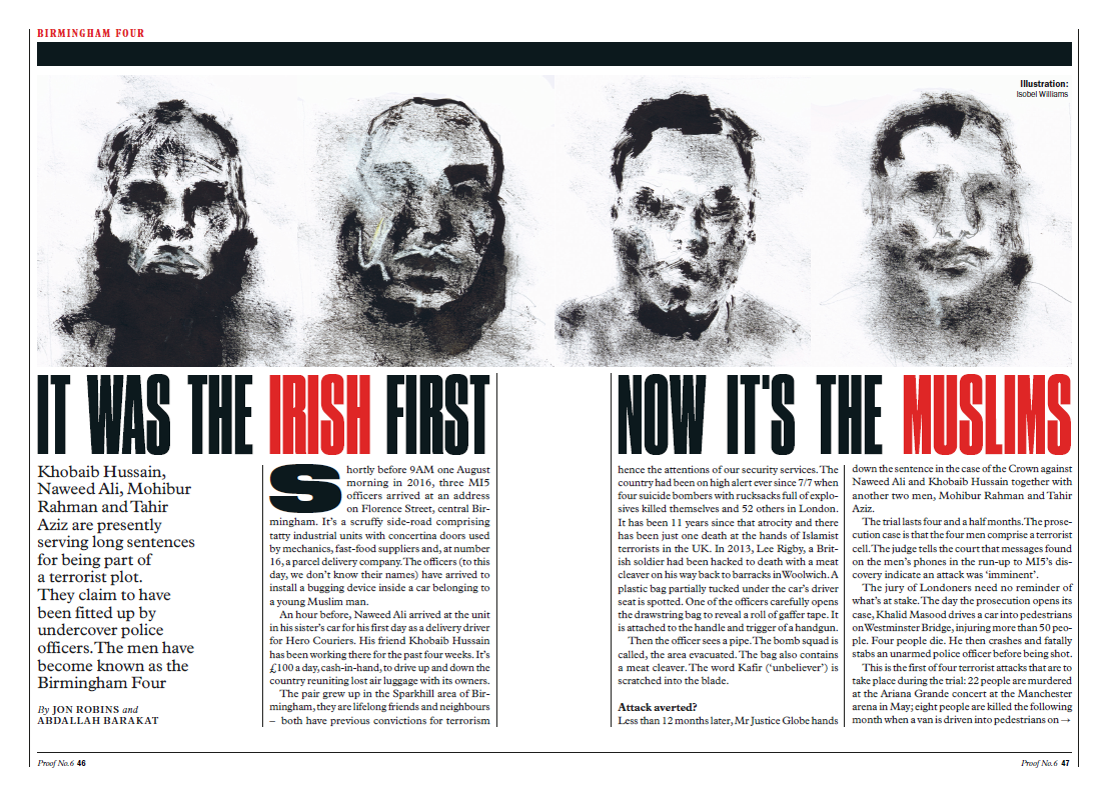
PROOF 6 – The Birmingham Four
The day after the jury’s verdict Khobaib Hussain’s barrister Gareth Peirce did something that she had never done before. She published a public statement: ‘We register our unqualified respect for the system we have of trial by jury in this country. But jurors can on occasion get things wrong.’
A long-read on the case was published in issue 6 of PROOF magazine, and is now available to read via The Justice Gap: The Birmingham Four: History repeating itself.
In May 2025 the Guardian picked up the case, The Birmingham Four: terrorist masterminds – or victims of a police fit-up?, recounting in detail the shocking texts that undercover officers had sent to each other during the trial.
Hussain’s sister has been campaigning on behalf of the men ever since. In this episode, we travel to Birmingham to find out why.