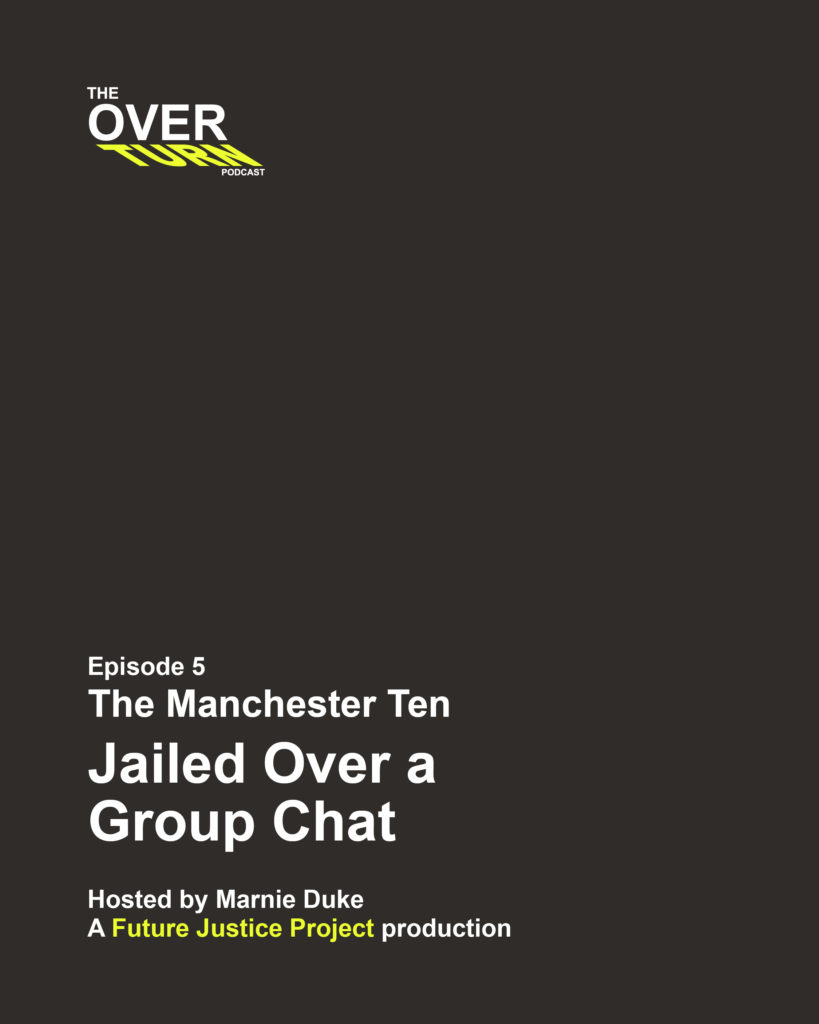

Episode 5 of The Overturn – The Manchester Ten: Jailed Over a Group Chat
Listen to the full episode below, or via Spotify.
In 2022, ten teenage boys were jailed for plotting ‘revenge attacks’ in response to the murder of their friend. The boys, some of whom were only present in the chat where an address was shared for a matter of minutes, were convicted of conspiracy to commit grievous bodily harm and conspiracy to commit murder. A narrative was created by the prosecution that the boys were members of a violent criminal gang, one that a lawyer representing one of them is driven by ‘institutional racism’.
On 5 November 2020, Alexander John Soyoye was killed. After Soyoye’s death, Ademola Adedeji was invited to a group chat with nine others, in which he sent 11 messages, shortly before leaving the chat, around 20 minutes after it had been set up. Adedeji also shared a postcode in the group chat.
Three violent incidents, involving two of the boys in the group chat, took place. Adedeji was not present for any of the incidents, and no one was harmed at the address that he gave, but all ten members of the group chat, The Manchester 10, were arrested and convicted for murder.
The prosecution argued that Adedeji and the others were part of a violent criminal ‘gang’ that had masterminded ‘revenge attacks’.
Keir Monteith KC represented Adedeji. He criticised the prosecution’s use of stereotypes and guilt by association when they asked the jury to conclude, as they closed the case, that the Applicant and three other defendants had become involved in gang culture: ‘Because of the area in which they lived, because they had an interest in drill rap with its themes of violence, drugs and criminality that we have heard about…Some of them became involved because of who they were friends with…’
Monteith said that the use of a ‘gang narrative for people who had no part in violence’ was used to build the prosecution’s case against Adedeji, and that ‘institutional racism’ helps ‘explain what went wrong in this case.’
Adedeji had his conviction overturned in January 2025. It followed a two-day appeal in December 2024 in which the human rights group JUSTICE highlighted concerns over racial stereotyping, the ‘adultification’ of black and ethnic minority defendants as well as the misinterpretation of drill music as evidence of criminal activity. As well as quashing Ademola’s conviction, the Court of Appeal granted appeals against the sentences of two, Omolade Okoya and Raymond Savi whose eight-year sentences have been replaced with four and a half years. In total, four boys convicted of conspiring to commit GBH and three boys convicted of conspiracy to murder, were granted leave to appeal against their convictions.
The case features in the previous issue of PROOF (Jailed over a Group Chat) in which documentary maker Fran Robertson argued that the only evidence against Ademola Adedeji was the 20 minutes he had spent in a group chat weeks before any violence took place.
In this episode, we speak to a campaigner about why she believes the boys’ grief was co-opted and constructed into something it wasn’t.