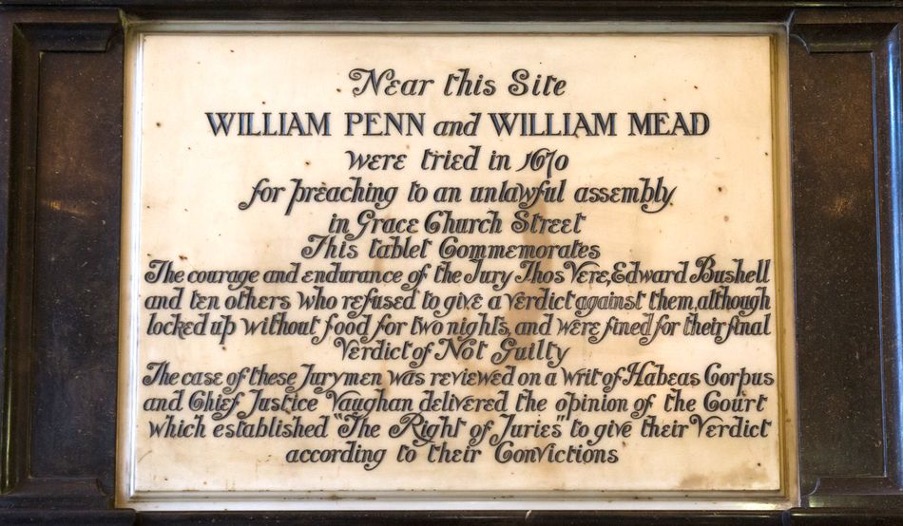

In 1670 the jury system as we know it was born with Bushell’s case. This is perhaps the most famous case in English history but Bushell himself was, in fact, not even on trial. Bushell was a juror, the foreman of the jury. A stone at the most revered Crown Court in the country, the Old Bailey celebrates Bushell’s case. It records that William Penn and William Mead both Quaker advocates of democracy and religious freedom, were tried ‘near this site’ for preaching to an unlawful assembly. The Old Bailey tablet commemorates ‘the courage and endurance’ of the jury who refused to give a verdict against the Quakers even though they were locked up without food for two nights by the trial judge for refusing to bring a guilty verdict.
Thankfully today judges don’t have such power; the habeas corpus the jurors took against their incarceration was successful and the principle of jurors alone deciding their verdict was established.
Fast forward 350 years and it’s not a jury facing prison today but a defence barrister, for referring to the Bushell case in his closing speech to the jury in another protest case. For his words Rajiv Menon KC is being prosecuted for contempt of court. Like the jury who were locked up in the Tower of London in 1670 these proceedings have no precedent. The complaint started with prosecution counsel’s reaction to Menon’s speech. It seems, of course, extraordinarily heavy handed that we have abruptly reached the stage a barrister can be being summonsed to Court and that no alternative has been found to address any concerns the Judge might have had. The even wider concern with these proceedings is that they will inevitably have a chilling effect on defence counsel in future speeches to the jury. Will counsel feel obliged to show their speeches to prosecution counsel to ensure they are sanctioned? Will the prosecution be deciding what can be said in political cases?
Menon denies breaching any legal orders, and if it is thought he might have done, he has made clear he certainly did not intend to do so. Customarily, where a trial judge is concerned about something that a barrister has said in a closing speech, the barrister is asked to correct the mistake, or the judge corrects the mistake in their summing up. That didn’t happen here. Menon is an experienced advocate who has provided representation in many important cases including for the bereaved Hillsborough families, and takes his professional duties very seriously.
If he is being prosecuted for mentioning what any member of the public or jury could read for themselves at the Old Bailey is there a danger of recreating the injustice reflected in Bushell’s case? It should be remembered that we have had juries for centuries as a careful balance in what David Lammy tweeted in 2020 are a ‘fundamental part of our democratic settlement’.
No one argues against the important and fair role of judges in case management of trials but more and more this seems to be extending into what defendants or defence counsel can say. Telling juries about history and that the Chief Justice Vaughan in 1670 answered the habeas corpus with a judgement ‘which established the right of juries to give their verdicts according to their convictions’ can surely not warrant the threat of prison? In a period where the current government seem intent on handing over swathes of cases to judge-only trials with ‘reforms’ absent from any manifesto, there’s an awful feeling of returning to the consistent attack on civil liberties experienced under the Blair government.
Matt Foot, co-director of Appeal and author of Charged: How the Police Try to Suppress Protest