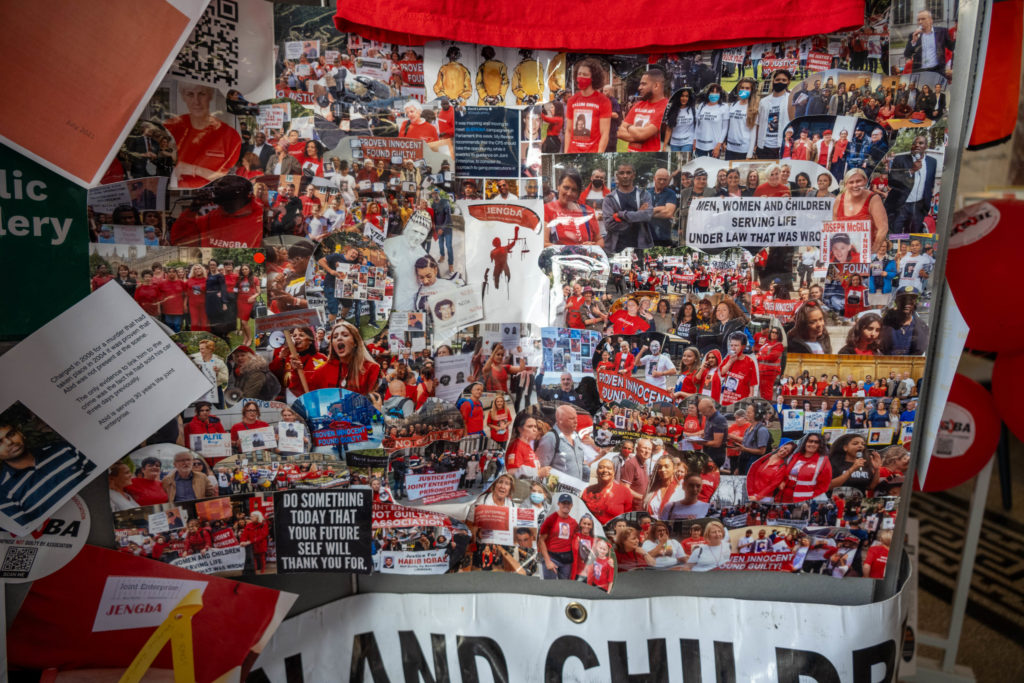

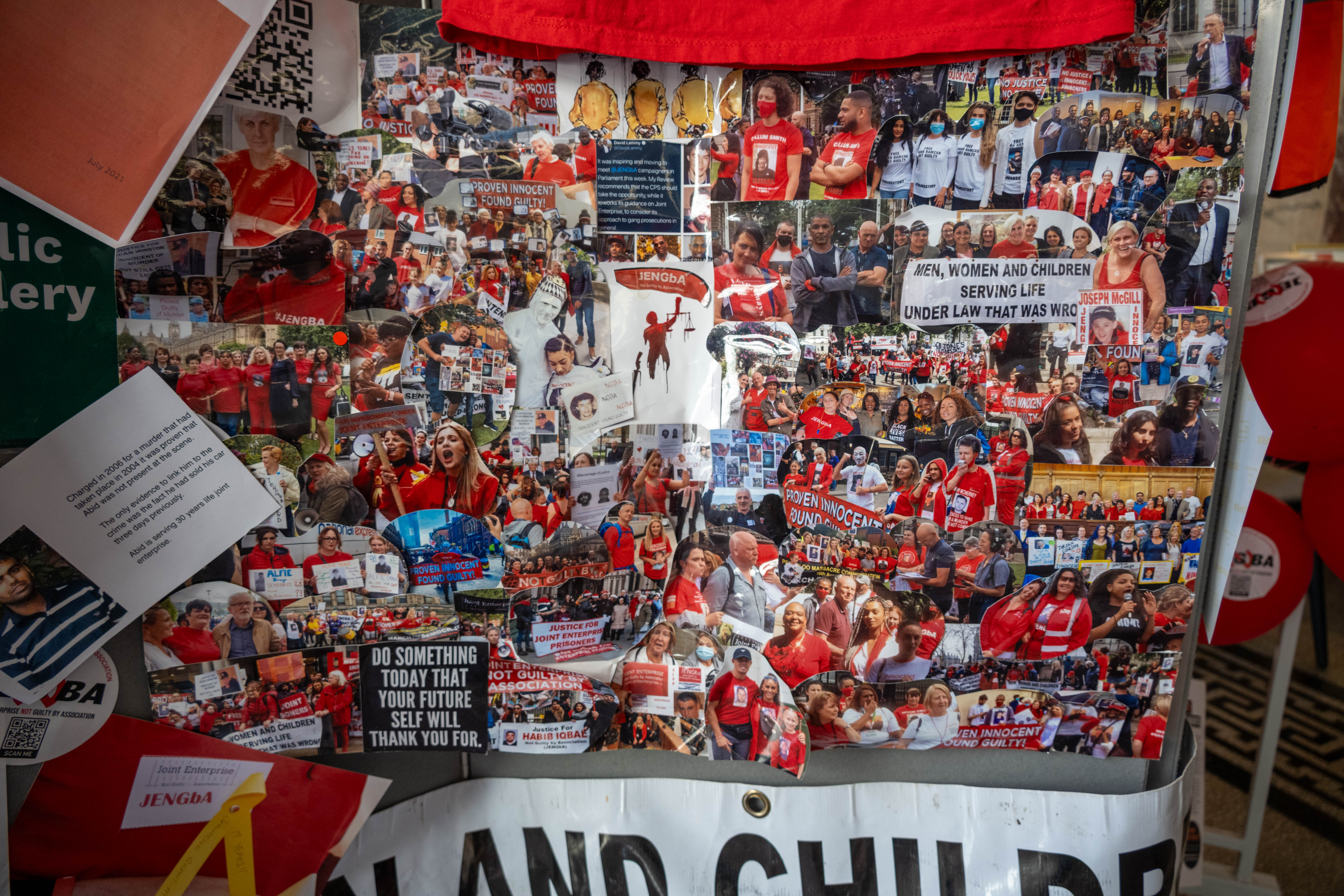
Earlier this month, the University of Westminster played host to Mothers of Injustice, a powerful photo exhibition celebrating the work of JENGbA – Joint Enterprise, Not Guilty by Association. For over 15 years, JENGbA has stood alongside those criminalised under the deeply flawed doctrine of joint enterprise (JE), as well as the families left to fight for justice on their behalf.
Founded in 2010 by Gloria Morrison and Jan Cunliffe, JENGbA has grown into a lifeline for more than 1,500 people convicted under joint enterprise. Many of those affected are young men, often children, disproportionately from racialised and working-class communities. But behind every conviction is a family, and more often than not, a mother whose life has been irrevocably changed.
The exhibition was inspired by research undertaken by Dr Nicola Campbell at the University of Westminster, whose work explores joint enterprise through a maternal lens. Rather than focusing solely on legal interpretations from lawyers, judges or the Criminal Cases Review Commission (CCRC), Nicola’s research asks a different question: how do mothers experience injustice?
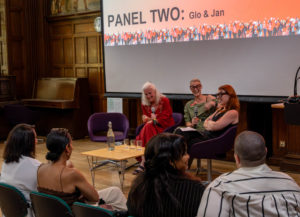
Gloria Morrison and Jan Cunliffe – in conversation with Nicola Campbell
Importantly, ‘mother’ is understood here in its broadest sense. It is not confined to biology but embraces anyone undertaking motherwork – the often invisible, unpaid emotional labour of caring for others and protecting communities in the face of state oppression. It is this work, so frequently overlooked, that sits at the heart of JENGbA’s campaign. For many involved in JENGbA, campaigning is an extension of mothering: continuing to love, support and protect a child when the state has failed them. These women are mothering individuals, families and entire communities across the country. What began around Glo Morrison’s kitchen table has grown into a movement that refuses to be ignored.
At the exhibition, it was impossible to ignore the sheer scale of that labour. Letters to the Crown Prosecution Service, government ministers, MPs, correspondence with prisoners, campaign leaflets, reports, photographs and years of relentless advocacy were projected across the walls of the University’s Regent Street foyer. Supported by Dr Megan Carnrite, the exhibition deliberately refused to let this work fade into the background.
This was not an exhibition designed to be politely admired before moving on. It interrupted the space, demanding attention. As Gloria Morrison and Jan Cunliffe explained, “We’re not going anywhere. They have to engage with us. They will, because they are wrong, and they know we are right.”
That determination echoed throughout the evening.
The private viewing was accompanied by a series of panel discussions, the first of which explored what it means to be a mother fighting the state. JENGbA women spoke openly about loving and supporting their children through criminalisation and lengthy prison sentences while navigating a system that had already taken so much from them. They described putting their own heartbreak aside to remain strong for their families, often becoming advocates, legal researchers and campaigners simply because they had no other choice.
Yet despite their pain, there was also hope. Each woman spoke of the profound comfort found within JENGbA – a community that not only understands the injustice of joint enterprise but also understands the emotional toll it takes on those left behind. What begins as campaigning often becomes family. A campaign family where grief is recognised, resilience is shared and no one has to carry the burden alone.
Joint enterprise remains one of the most controversial forms of secondary liability in England and Wales. Intended to hold people accountable for serious offences committed by others, it has instead left thousands of individuals convicted despite not inflicting the fatal blow or, in some cases, not even being present when the offence took place. The consequences reach far beyond the courtroom resulting in families being torn apart, mothers, sisters, aunts, and friends become lifelong campaigners, and entire communities continue to bear the weight of a justice system many believe has failed them. Despite years of campaigning, profound injustices persist.
Mothers of Injustice is a tribute to the women who refuse to stop fighting, a recognition of the care that sustains movements for justice, and a reminder that behind every campaign are people whose love has never wavered.
To learn more about JENGbA, support its campaign, or access resources for those affected by joint enterprise, visit https://jengba.co.uk. If you are someone undertaking this kind of caring through campaigning and would like to share your experiences as part of Dr Nicola Campbell’s research, you can contact her at Camben1@westminster.ac.uk.