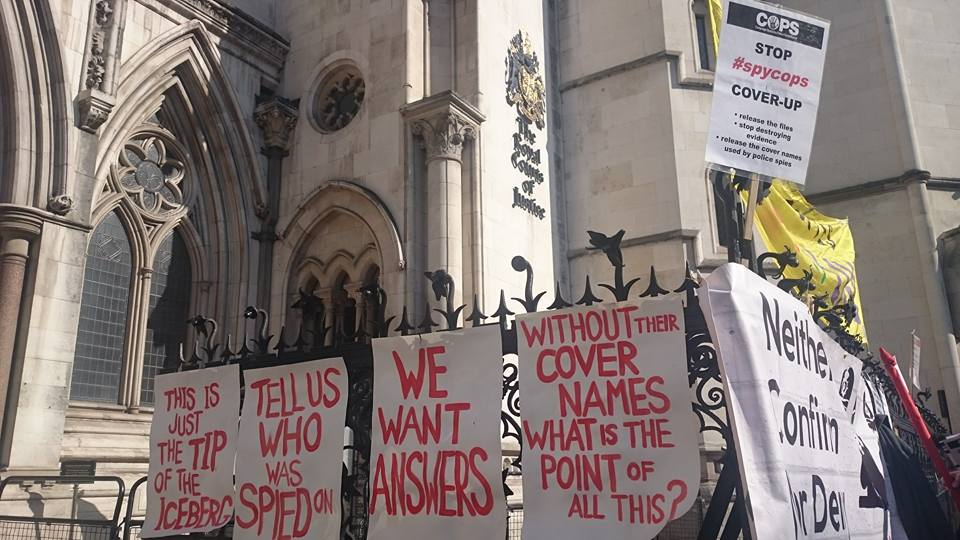

A consultation launched in July by the Home Office over the summer has cast the future of the Undercover Policing Inquiry, which has been running since 2015, into doubt. Since the consultation did not include the option of the Inquiry continuing in its current form, as a full, statutory inquiry, activists boycotted the Home Office consultation, arguing that it had been predetermined.
The Campaign Opposing Police Surveillance (COPS), an activist group representing victims of undercover policing, has now published its own report. The independent report, based on over 2,600 responses, has set out the case in favour of allowing the Inquiry to complete its work. The report argues that the Home Office consultation, as well as being predetermined, was in violation of the Gunning principles, the rules governing the fairness of public consultations. Bizarrely, the Home Office consultation cited the (not yet enacted) Public Office (Accountability) Bill (the so-called Hillsborough Law) as a justification for curtailing the work of the UCPI. Ken Derbyshire, chair of the Hillsborough Justice Campaign, said: ‘Survivors haven’t fought for all these years so a law (not yet enacted) can be used to deny other victims truth and accountability.’
This is not the first time that the Home Office has tried to interfere with the Inquiry. Campaigners point to attempts by Suella Braverman in 2024, during her tenure as Home Secretary, to severely limit the scope of the Inquiry. As a compromise the Inquiry chair, Sir John Mitting, agreed to an ultimately unachievable deadline of December of this year, which was quietly abandoned in 2025. Campaigners argue that the numerous delays that preceded the hearing of evidence from 2020 were caused by police and state obstruction. Dave Morris, a core participant and former McLibel defendant, said: ‘The police spent five years trying to sabotage this Inquiry with endless secrecy applications, closed hearings, and redactions. Now Ministers want to cite those self-inflicted delays and costs as an excuse to shut it down before it examines modern political policing.’
The new report argues that that curtailing or limiting the Inquiry will leave vital questions about the reality of undercover policing unanswered, including the level of state-corporate collusion and the potential number of miscarriages of justice. The report also argues that the Home Office’s role as the managing department for the Inquiry represents a serious conflict of interest. ‘Lisa’, from Police Spies Out of Lives, a campaign group representing women who were deceived into sexual relationships by undercover police officers, said ‘There is a conflict of interest at the heart of this review, because the Home Office is itself a subject of investigation for the role it played in authorising and funding abusive undercover units.’
The Inquiry has so far focused on the Special Demonstration Squad (SDS), a unit of the Met’s Special Branch. The next stage of the Inquiry’s work will investigate the National Public Order Intelligence Unit (NPOIU), a unit set up in 1999 and disbanded in 2011 following the exposure of one of its number, Mark Kennedy, as an undercover police officer in 2010. Unlike the SDS, the NPOIU was a national unit that drew from multiple police forces. From 2006, it was managed by the Association of Chief Police Officers (ACPO), a representative body and private company that has since been superseded by the National Police Chiefs’ Council. ACPO was entirely funded by police forces and the Home Office. Accounts show that in 2007, after ACPO took over the coordination of the NPOIU, it received £17m in project funding, the majority of which was provided by the Home Office. Lord Hanson of Flint, the minister with responsibility for inquiries and who is overseeing the consultation, was last a Home Office minister back in 2009 when he had responsibility for counter-terrorism policing, including oversight of the NPOIU. ‘Lisa’ further said ‘Letting a minister decide whether operations on his own watch will be investigated can’t be right’.
The report also points out that the NPOIU was established at the same time as the legal regime meant to protect the public against the types of abuse committed by undercover officers: the Human Rights Act in 1998 and the Regulation of Investigatory Powers Act (RIPA) in 2000. The Inquiry has previously heard evidence in respect of the SDS that RIPA authorisations were formulaic and had no meaningful impact on previous SDS practise. Also unlike SDS officers, NPOIU spies were closely supervised by their cover officers. Kennedy who infiltrated environmental and leftwing groups from 2003 to 2009, engaged in precisely the same sorts of abuses and deceptions as SDS officers. Kate Wilson’s successful claim against the Met in the Investigatory Powers Tribunal ultimately found in 2022 that his deployment and wider intrusion by the NPOIU of her life were egregious violations of her human rights. It was revealed by The Guardian earlier this year that the Crown Prosecution Service is currently considering criminal charges against Kennedy and eleven other officers.
‘Tina’, a woman who was deceived into a sexual relationship by an NPOIU officer, told the consultation: ‘NPOIU officers operated entirely under RIPA, yet predatory intimate relationships and severe human rights breaches continued unabated, as did massive levels of unchecked collateral intrusion, open-ended fishing expedition deployments, and disproportionate and unnecessary intrusion that could not lawfully be authorised under RIPA.’
In response to the Home Office consultation, campaigners are demanding that all proposals to limit the scope or duration of the Inquiry should be abandoned, that a new chair is appointed for the remaining tranches, and that the police and public authorities be sanctioned for future attempts to delay the work of the Inquiry. Shabana Mahmood, the Home Secretary, is expected to make a final decision about the future of the Inquiry early in the new year.
Support the Justice Gap, buy PROOF