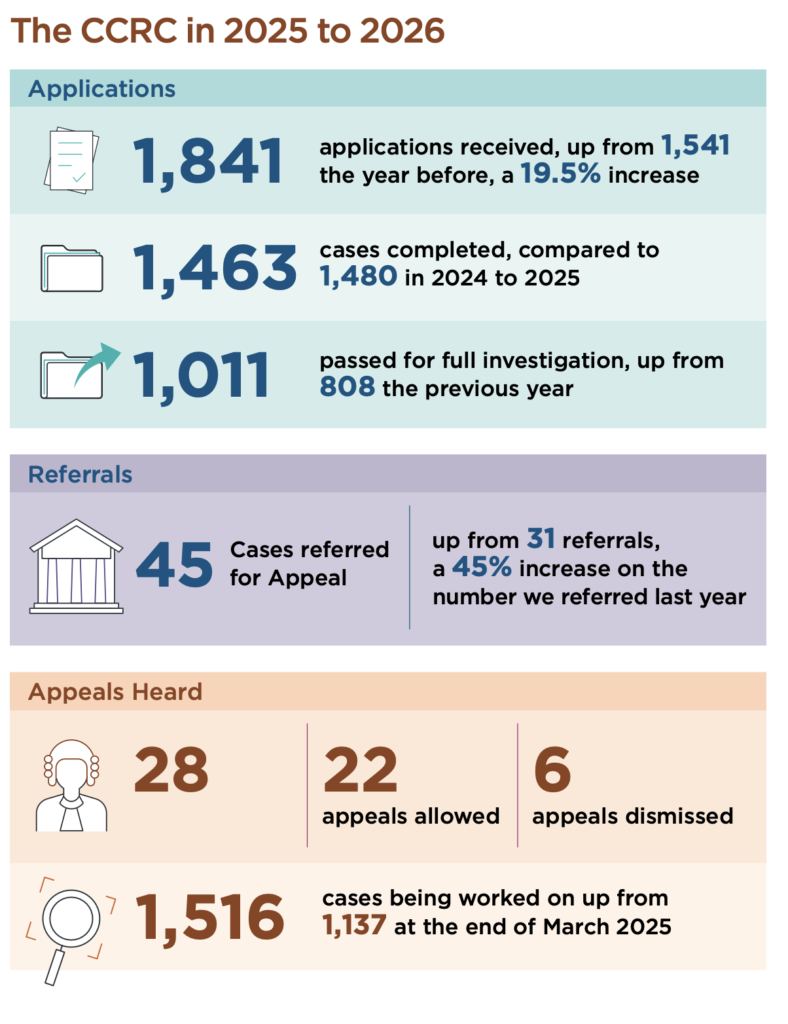

The Criminal Cases Review Commission referred 45 cases back to the appeal court last year, one of the highest numbers of referrals in its 30 year history and an 80% increase on two years ago. The miscarriage of justice watchdog last year received more applications than ever before, according to its annual report published yesterday: 1,841 applications, almost 20% up on the previous year.
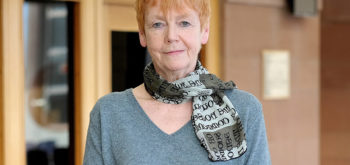
The report reflects a new period of relative stability and recovery for an organisation that was left in crisis as a result of its serial mishandling of the Andrew Malkinson case and the resignations of its previous chair and chief executive. ‘We have seen a significant change in the last year but every member of our staff and every commissioner shares commitment to the rigorous investigation of miscarriages of justice,’ said Dame Vera Baird, who has been appointed interim chair for another 12 months from December. ‘With 1800 applications, we have referred more cases to the appeal courts, not quite its highest number ever, but a strong effort,’ she added. Baird is now joined by a new interim CEO, Tracey Calleia.
 The CCRC’s focus on the number of referrals is itself significant and represents a marked change from her predecessor who repeatedly dismissed concerns from commentators over the collapse in the number of referrals (once insisting that referrals were ‘not the be-all and end-all’).
In her introduction, Dame Vera says that the furore over the exoneration of Andrew Malkinson made ‘an urgent deep dive into that casework function imperative’. She says that the recent report by HM CPS Inspectorate was the first time in the commission’s three decade history that ‘external eyes’ had been cast over its files. ‘I am pleased to say that in all 60 sample cases examined, the inspectors found that our casework teams had reached sound conclusions in their recommendations to Commissioners about whether the case should be referred or not,’ she writes. ‘The Inspectors also found staff at every level committed to the organisation’s work.’
However, she also recognises that inspectors had made clear that the CCRC needed to ‘urgently’ improve quality assurance ‘which they found to be inconsistent and lacking structure’. The inspectors recommendations have been accepted and will form the CCRC’s ‘plan for change’.
You can read a sceptical analysis of the CPS Inspectorate report on the Justice Gap raising concerns about the limited nature of the CPS review which, for example, neither looked at complex cases nor the role of commissioners in quality assurance.
According to the annual report, this year the CCRC made 45 references to the Court of Appeal and crown court – a 45% increase on the previous year (31) and since the establishment of the CCRC in 1997 it has only referred more cases on two occasions.
Typically, the CCRC receives 1,500 applications a year – this year’s record-breaking figure is 300 more than the previous year. The report acknowledges that this increase itself is putting pressure on the CCRC. ‘The rising number of applications has had the impact on the pace of our reviews because our staffing levels have not increased as quickly as our intake,’ the report states.
In her introduction, Dame Vera points out the CCRC’s new ‘thematic approach’ to casework – again marking a break with her predecessor which did not invoke the commission’s powers to identify structural problems within the criminal justice system. Baird has identified three areas of concern: Imprisonment for Public Protection (IPP) sentences, joint enterprise cases; and the Grooming Gangs Inquiry. ‘As well as referring individual cases to the courts, the CCRC must point out when its work suggests that serial injustices are being caused, so that government and the courts can consider whether law or procedure need to change,’ she writes.
In August 2025, the CCRC announced a review of IPPs where a judge failed to properly consider the age of maturity of the offender. Up to March this year, the CCRC received almost 150 applications for a review and in January it referred the first five sentences to the appeal courts.
The annual report revealed that for the second year running they were more than 100 long-running cases. A long-running case is a one that the CCRC has had for two years or more. The concern has been that the CCRC had been increasingly ‘parking’ difficult cases in recent years. That number has been growing year-on-year from 2020 when it was just 43 and topped 100 for the first time last year when it reached 113. The CCRC has made progress on the backlog over the last 12 months – the figure is now 102. The CCRC’s aim is to have no more than 40 long running cases. According to the annual report, the CCRC is reviewing those cases with ‘greater emphasis on the scrutiny of fewer cases’.
Commentators have previously pointed out that the CCRC is not well-served by its own KPIs – key performance indicators – which are set out in yesterday’s report. Nearly all refer to the organisation hitting deadlines – with almost no reference to quality of casework – encouraging the organisation to ‘close down’ cases rather than identify injustices. For example, KPI 1 relates to the aim of completing 85% of all cases in 12 months of receiving an application. Last year, the commission shut down more than three-quarters, 76%.
There is also a progress report on the recommendations flowing from Chris Henley KC’s scathing review of the CCRC as a result of the Malkinson case including a review of all DNA cases. The CCRC identified 5,695 cases – more than half (55%) were excluded on the basis that there was no challenge to the identity of the alleged defender which left 2,553 cases that were passed on to a special ‘forensics opportunity’ team. Of that number, the team has completed 728 cases with 69 resulting in new enquiries being made such as seeking further material for testing. ‘So far three cases have produced new forensic evidence,’ the report says. ‘In these cases some of the results do not assist the applicant and the new evidence lend support to the original conviction.’
It now appears that there was no internal review of cases following the exoneration of Victor Nealon in 2014 (a case that has been reported extensively on the JG and one that had striking similarities to the Malkinson case, here) – despite press reports that there had been a ‘trawl’ for similar cases which might have meant other cases including Andrew Malkinson could have been identified. The annual report states: ‘We have found no record of an internal review of cases following the Nealon decision.’
Support the Justice Gap, buy PROOF