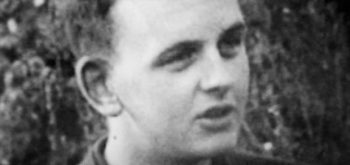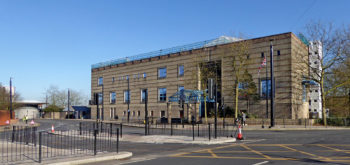
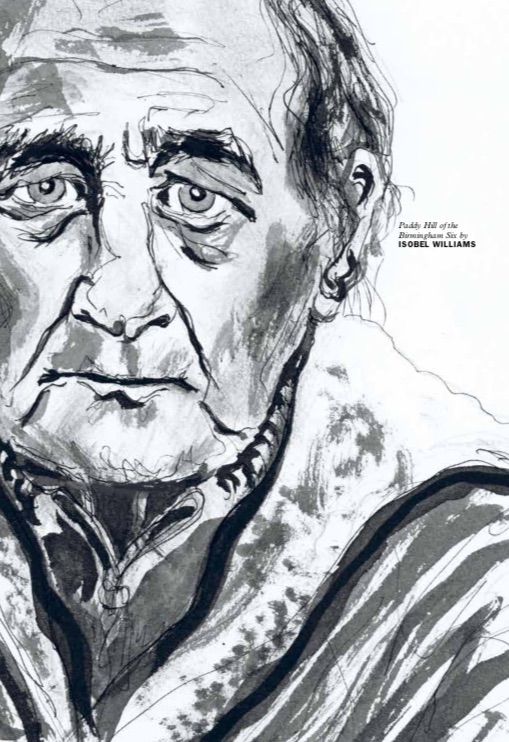

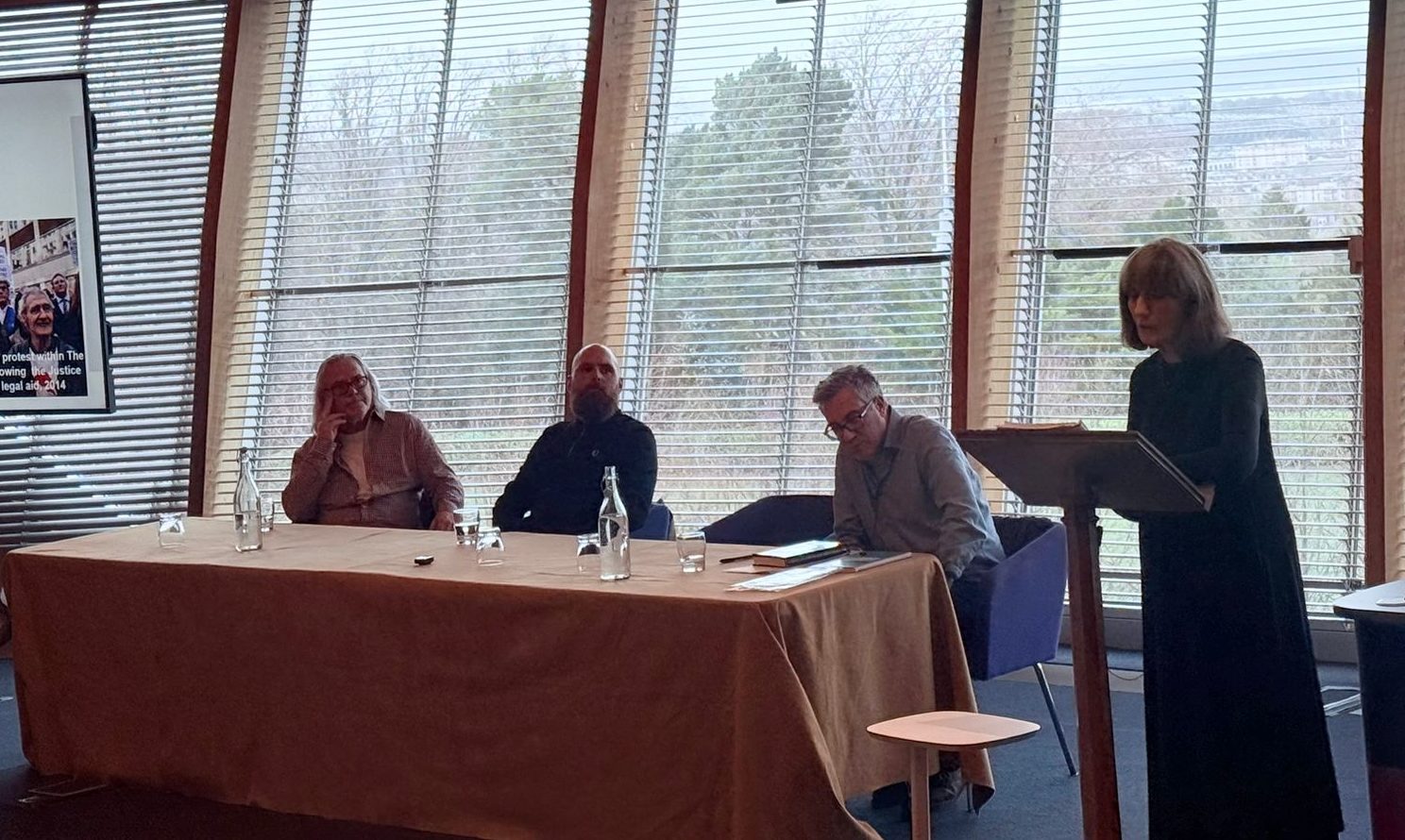
REMEMBERING PADDY HILL: Gareth Peirce has paid a moving tribute to her ‘friend and comrade’ Paddy Hill at a first annual memorial lecture. The veteran human rights lawyer was speaking at an event organised by MOJO, the Glasgow-based group Hill set up to help the wrongly convicted in 2001.
Paddy Hill died on December 23, 2024 at his home just after his 80th birthday. ‘The whole intention of every arm of the British state was that Paddy should die in prison, not at home,’ Gareth Peirce told the audience at Edinburgh Napier University.
Hill spent 16 years in prison wrongly convicted of being involved in an IRA bombing campaign fighting to clear his name and that of the other men; and the rest of his life he dedicated to fighting on behalf of innocent people behind bars. He was ‘a total fighter’, said Peirce.
- MOJO announced at its first annual Paddy Hill Memorial Lecture that it has been working with award-winning documentary film-maker Hannah Currie and executive producer Sandra Leeming on a campaign film about its clients.
- Support the project HERE.
- Illustration Isobel Williams for PROOF magazine issue 4, the Legacy of the Birmingham Six
 Gareth Peirce recalled how, years after his conviction was overturned, a psychologist and a psychiatrist (Dr Jim MacKeith and Dr Gisli Gudjonsson) conducted a survey of wrongly convicted prisoners in cases where there had been false confessions. Paddy Hill withstood the torture inflicted on him and other five – Hugh Callaghan, Gerard Hunter, Richard McIlkenny, William Power, and John Walker. This variously included brutal beatings, mock executions, being set upon by dogs and threatened with being thrown out of windows.
Despite the onslaught, Paddy Hill didn’t ‘confess’. ‘When they tested Paddy, he went off the top of any measurable scale for resistance. He was neither suggestible nor compliant,’ Peirce said. ‘He was a total, total fighter. It wasn’t just that he was the bravest of the brave he was, but he had what it took to achieve the unachievable.’
‘The fact is, it was Paddy, always Paddy, who drove the case forward – and after all hope disappeared. He was a truly exceptional human being. When by complete accident of fate, he and five others faced the unfaceable. When that happened, he was equipped to achieve the unachievable.’
Gareth Peirce on Paddy Hill
Gareth Peirce represented Paddy Hill and other members of the Birmingham Six as well as Gerry Conlon of the Guildford Four – see below for her account of Paddy’s fight for justice.
 Gareth Peirce was also joined by Matt Foot, co-director at APPEAL and Patrick Maguire of the Maguire Seven. Foot spoke about the crisis at the organisation that was set up on the recommendation of a royal commission established on the day that the Birmingham Six left the Old Bailey as free men. He quoted Hill’s own damning assessments of the Criminal Cases Review Commission: ‘It was very good for the first 12 to 18 months,’ Hill said. ‘But then the gates came down, and then they locked the gates.’
Matt Foot represents Eddie Gilfoyle who was convicted of the murder of his wife in 1992 and who has always maintained his innocence – for more on his case, see here. Paddy Hill supported Gilfoyle’s campaign – there was talk of him living with Hill on his release. Gilfoyle paid tribute to his friend: ‘Paddy had suffered a terrible miscarriage of justice himself. He dedicated his life to help others in the same situation. He was a man who fought the justice system for others and gave help and support to families in their fight.’
‘Because of Paddy, the system knew, but they didn’t like it, that people who were wrongly convicted now had hope due to this titan of a man. I miss him every day, and we all must carry on the work he started. God bless you, Paddy.’
Eddie Gilfoyle
Foot recalled how he had once described the CCRC as ‘an office-bound, moribund organisation’ in 2018 when they rejected an application made on behalf of Gilfoyle seven years earlier. ‘I apologise for that statement,’ he said. ‘We found out last year that the CCRC no longer go to the office in Birmingham. They no longer attend. They have home working. How can you resolve these cases, these complex cases, if you’re sitting on your own at home, not talking to people, not rubbing up shoulders, not thrashing ideas together? The organisation has become a shell of an office with nobody in it – the exact opposite of what was needed.’
The CCRC was ‘the first crisis’. The second was the Court of Appeal, Foot said. He quoted the blunt assessment of Paddy Hill (as spoken in an interview with the Justice Gap).
‘Our criminal justice system is probably one of the best in the world. It’s not the system that’s wrong. It is the bastards who sit on the bench who are indoctrinated into preserving the status quo.’
Paddy Hill
Patrick Maguire was just 13 years old when he was arrested at his home in west London as the youngest of the so called Maguire Seven – an entire family found guilty of running an IRA bomb factory from their Kilburn kitchen. They were wrongly convicted in 1975 and had their convictions quashed in 1991. ‘I don’t dwell on it too much,’ Maguire told the audience. ‘But I can’t hide from the fact that I was a child when this happened. It goes without saying it had a big impact.’ He is now an artist – his work appeared in in PROOF issue 4. ‘My life turned black and white – colourless overnight – after we got arrested,’ he told the audience.
He gave his support to the MOJO film project. ‘I hope one day, when this film is done, that people will see it, they’ll be shocked and stunned, and they will cry – and they will laugh somewhere in there as well. And for my own self, my children, my grandchildren, for them, things like this need to be done. So when I’m not around one day to let them know that wrong was done but we put it right.’
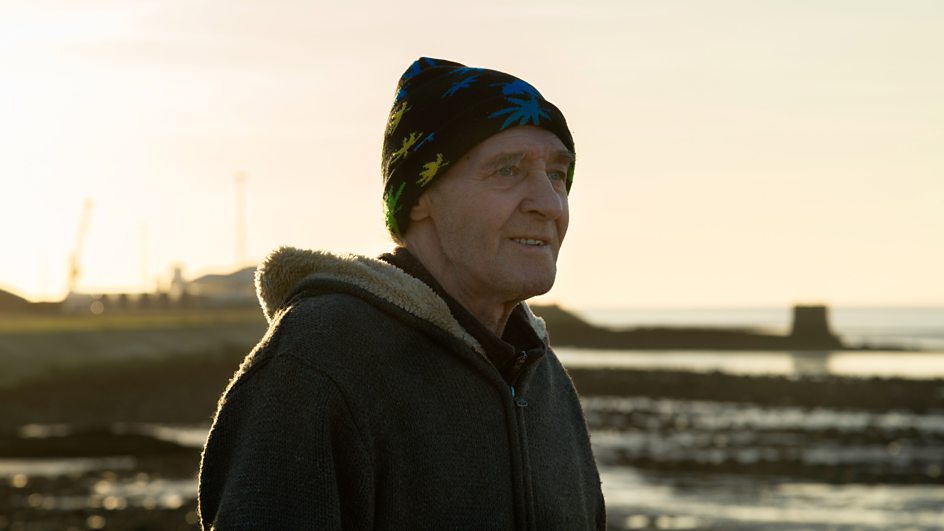
Gareth Peirce recalled a young Paddy Hill as ‘a 15-year old happy tearaway’ – exceptionally bright, a voracious reader and good at mathematics. But, the prospects for a young catholic boy in Belfast in the late 1950s were limited. As Peirce recalled Hill joking: ‘If you were a Catholic wanting to go to Queen’s University in Belfast, the only way you get in is if you donated your body to science.’ However that young Paddy was ‘pitchforked’ from Belfast to Birmingham when his father was sacked from his job for being a Catholic.
Then came the Birmingham pub bombings on November 21, 1974 – the worst mainland attack since the Second World War, claiming the lives of 21 people and injuring hundreds. In the immediate aftermath, Hill and the others were ‘pulled off a train’ traveling from Birmingham to catch the Heysham ferry to Belfast on their way to a funeral of a friend.
As Peirce related: ‘His extreme ill-fortune was that police who were called to investigate were the infamous, corrupt, brutal West Midlands Serious Crime Squad and the forensic scientist who was on call that night, Dr Skuse, was incompetent, mendacious and hopeless.’
‘It was the end. There was nothing left. But he was determined to find a way.’
The six men were ‘smashed to smithereens in a Birmingham police station’. ‘When they emerged with the marks to show it, the solicitors at court failed to log the injuries, but still managed to get legal aid forms signed,’ recalled Peirce. The men were taken to Winston Green Prison ‘where the reception for the men was to leave blood, teeth – Paddy’s teeth – all over the floor of the prison’. So, as the lawyer put it, the evidence of the beating by the police was ‘satisfactorily eradicated’.
It was the courts (in the person of Lord Denning) that completed the cover-up of the police’s violence when they closed off the men’s opportunity attempts to sue West Midlands Police with a speech that has since become infamous. In 1980, the then Master of the Rolls upheld an appeal by the West Midlands Police against a civil action brought by the Birmingham Six for injuries they received in custody. Contemplating the seemingly unthinkable prospect of the police framing innocent man, Denning said that this was such ‘an appalling vista that every sensible person in the land would say: “it cannot be right that these actions should go any further. If the six men win, it will mean that the police were guilty of perjury, that they were guilty of violence and threats, that the confessions were involuntary and were improperly admitted in evidence…”.’
But even this knock-back didn’t deter Hill. In fact, Gareth Peirce reported that the hopelessness of the situation prompted the prisoner into action writing ’up to a thousand letters’. ‘Mine arrived soon after, in the early 1980s,’ she recalled. ‘He was in prison, tortured mentally by the fact of the conviction. He was in permanent protest.’ The lawyer recollected being stuck in the visitor’s queue at HMP Gartree behind a man who had arrived to fix the sewing machines. He was asked how long he was likely to be, he replied ‘quite a long time’. Hill had smashed up every sewing machine in the workshop.
Peirce recalled his behaviour as ‘self destructive’ but not ‘negative’. ‘Paddy was not passive when I met him. He said: “Listen, sweetheart, you may be a good lawyer. I don’t know, and I don’t care. What I hope is you understand how it works, and you’ll help me find a way through this.” He was determined. It was the end. There was nothing left, but he was determined that there was a way. For the next almost a decade, we were comrades in arms – to find a way. That was the battle… to find a way. And for the 35 years that followed, he was also my comrade and my friend.’
The lawyer described how the pair ‘stumbled along sometimes as if we had only a white stick to guide us’ – attracting the interest of Chris Mullin, the former MP who was then the editor of The Tribune who went onto champion the Birmingham Six. Mullin had a friend at ITV’s leading investigative program, World in Action which went on to make the documentary Who bombed Birmingham? One of Paddy Hill’s thousand letters landed at the office of his local Gartree MP, Sir John Farr, a Conservative MP for Harborough. Peirce recalled him as ‘a serious, good man… who read all the papers and told Paddy he believed he was innocent’. Then a former police officer, Tom Clark came forward who had been on duty in the police station ‘when the men were being battered to death’.
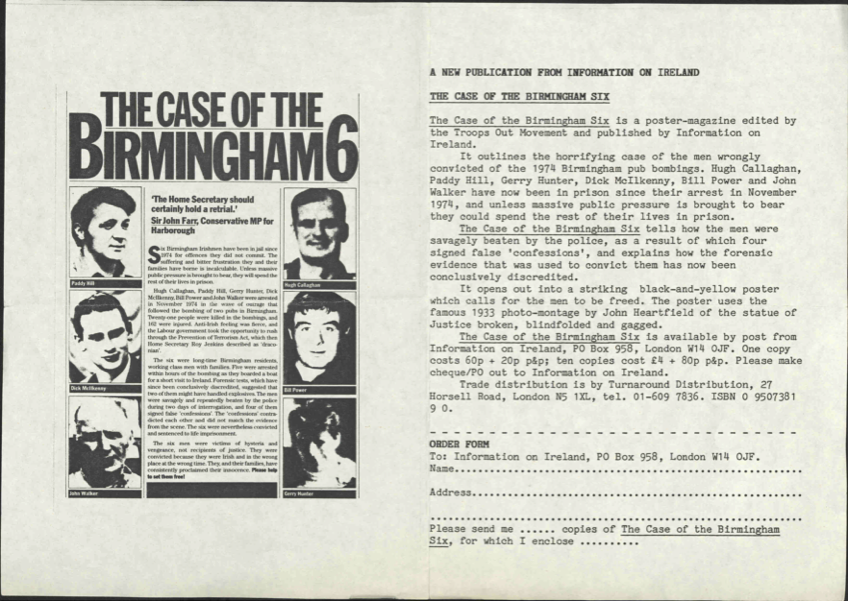
According to Peirce, Clarke wasn’t the best witness in the world – he had been dismissed for petty theft – but the cumulative impact of a slowly building campaign meant ‘there was no option but for the Home Office to refer the case to the Court of Appeal’. An outside force, Devon and Cornwall police, was brought in to investigate and seize materials from the West Midlands Police. It still wasn’t enough. The Court of Appeal ‘turned its face against all of the evidence’, including more former police officers who had observed the ‘mock executions, threats, beatings in the police station in the five days they were there’.
By this time, the West Midlands Serious Crime Squad was ‘imploding’. ‘There had been too many beatings, too many false confessions, too much evidence that things were like the Wild West, totally uncontrolled,’ Peirce recalled. The solicitor had sent letters to everyone her firm represented in prisons around the country asking if any had been convicted on the basis of West Midlands Serious Crimes Squad evidence. She then sought their prosecution papers which were full of ‘verbals’, where the police alleged that a suspect said something which was denied. It wasn’t subtle, Peirce recalled. ‘There would be West Midlands dialect in the confession, whether the person was from Scotland, Wales, Devon or Cornwall.’’
On October 19, 1998 the Guildford Four were released sending shockwaves, through the system. Finally, the Irish government (‘astonishingly late’) expressed its concern about the Birmingham Six. ‘Every person in Ireland knew by now about the Guildford Four and the Birmingham Six, even if those in England didn’t, and then Irish Americans, a constituency of 40 million Americans of Irish descent, took an interest,’ Peirce recollected. There was ‘a pincer movement of political pressure’. The ‘clincher’ was Devon and Cornwall Police seizing papers amidst ‘a mad dash’ at WMP records office who were busy destroying notebooks – but too late. ‘Those notebooks didn’t disappear,’ the lawyer said. ‘They were retained and they showed, provably, that all of the interviews had been made up. Indentations on paper underneath in a notebook showed where something had been changed. A page had been ripped out, but the indentation was still there and proved what the six men had said from start to finish.’
Beyond treatment
On March 14, 1991 the six men had their convictions overturned and they left the old Bailey as free men. ‘In the years after, what Paddy gave was as astonishing as what he gave to the case he’d been convicted of. It was Paddy who did it. It was Paddy who got the six men out, his initiatives. But for them we wouldn’t be here talking about this. Paddy and the others would have died in prison or still be alive and suffering and their families.’
‘What he did when he came out was just as astonishing,’ said Peirce. ‘His exceptional transposition of understanding, comprehension of what was necessary, and direct action was shown all over again when he came out.’ It came at a cost. Hill suffered from post traumatic stress disorder which means ‘in its most vivid form, the person suffering from it, the trauma is reactivated. They suffer it again and again.’ Doctors who examined the Birmingham Six, Guildford Four and other miscarriages of justice found that the damage suffered by victims of wrongful wrongful conviction was ‘more extreme than the victims of extreme physical trauma, like a violent accident’.
‘When Paddy came out, he observed this in himself. It couldn’t be treated. It was beyond treatment in Paddy. It was in too extreme a form, and ironically, some of his self-protective mechanisms that were there in prison weren’t there anymore.’
She finished her lecture by observing that he did the most extraordinary thing when he set up MOJO. ‘So in some ways, this is an apology, because it’s not possible to say what should be said about Paddy,’ she said. ‘But he is one of the most extraordinary historic figures there has been in the history of this country, and somehow it doesn’t quite get seen that way. No, it’s other things. It could be a television program that did it, or someone thinks it’s the lawyers who contributed. I can tell you it was Paddy.’
Support the Justice Gap, buy Proof