
Filmmakers Jemma Gander and Fran Robertson have been following the case of a man protesting his indeterminate prison sentence. What they found was a fragile prisoner, Joe Outlaw, putting the discredited IPP sentence on trial. The following appears in the latest issue of PROOF magazine (issue 7) – now out.
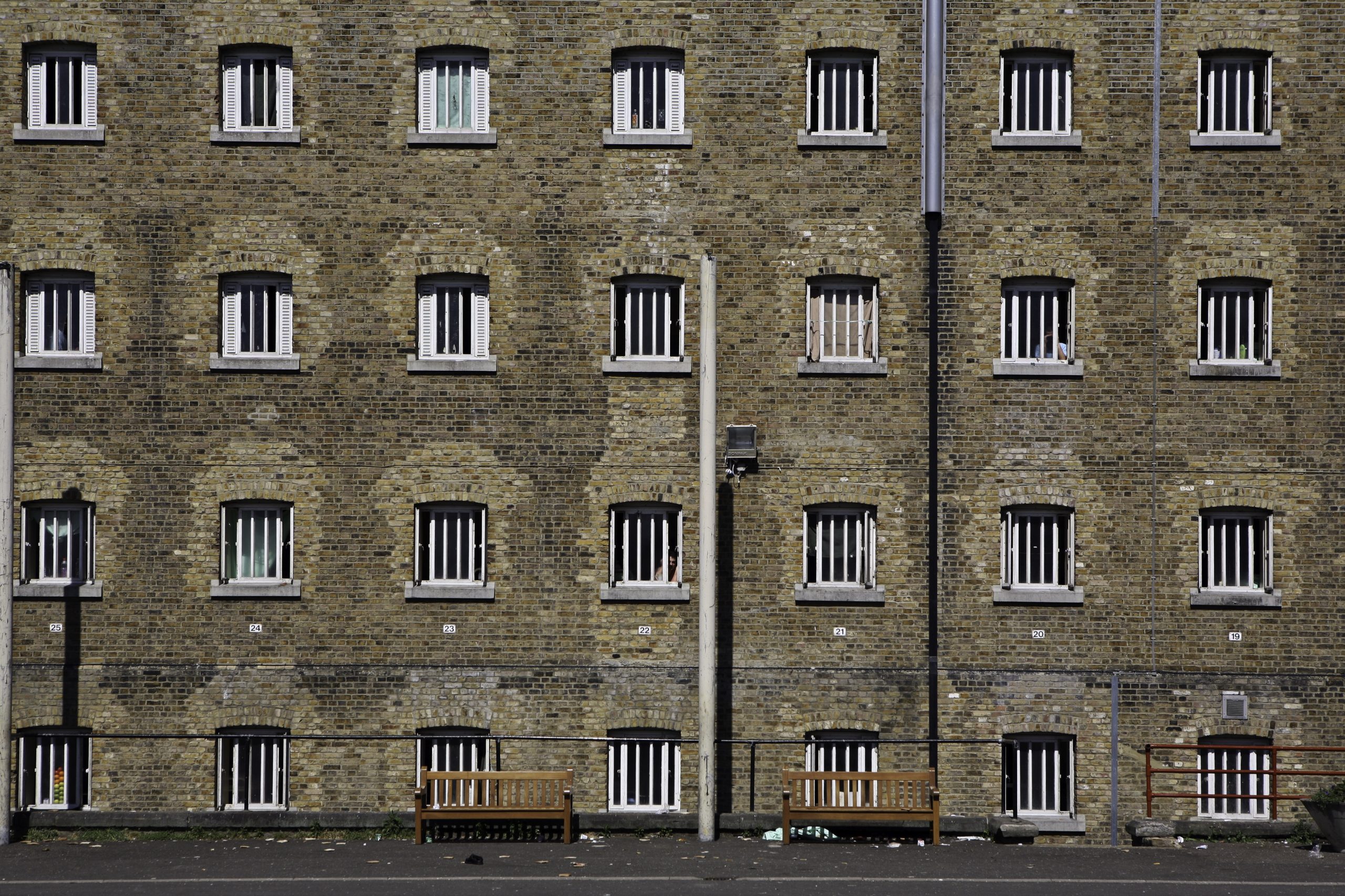
 It is a grey July day in 2025 at Teeside Crown Court in Middlesbrough. Outside the court building, a group of women are erecting a pasting table with a banner that says ‘Free IPPs and let them go home to their families.’ We are here because we have been filming with two women whose brothers are both serving Imprisonment for Public Protection (IPP) sentences. Today they are here to support Joe Outlaw, a high profile IPP prisoner who has been charged with causing £175,000 of damage to his cell and to the roof of HMP Frankland.
But this is more than a case of criminal damage caused by a serving prisoner. The judge has allowed Outlaw’s legal team to run the defence of duress, and they will argue that the stress caused by the indefinite nature of the IPP sentence led to his offending. Over the next week, the IPP sentence and the effects that an indefinite prison term has on mental health will be laid before the court.
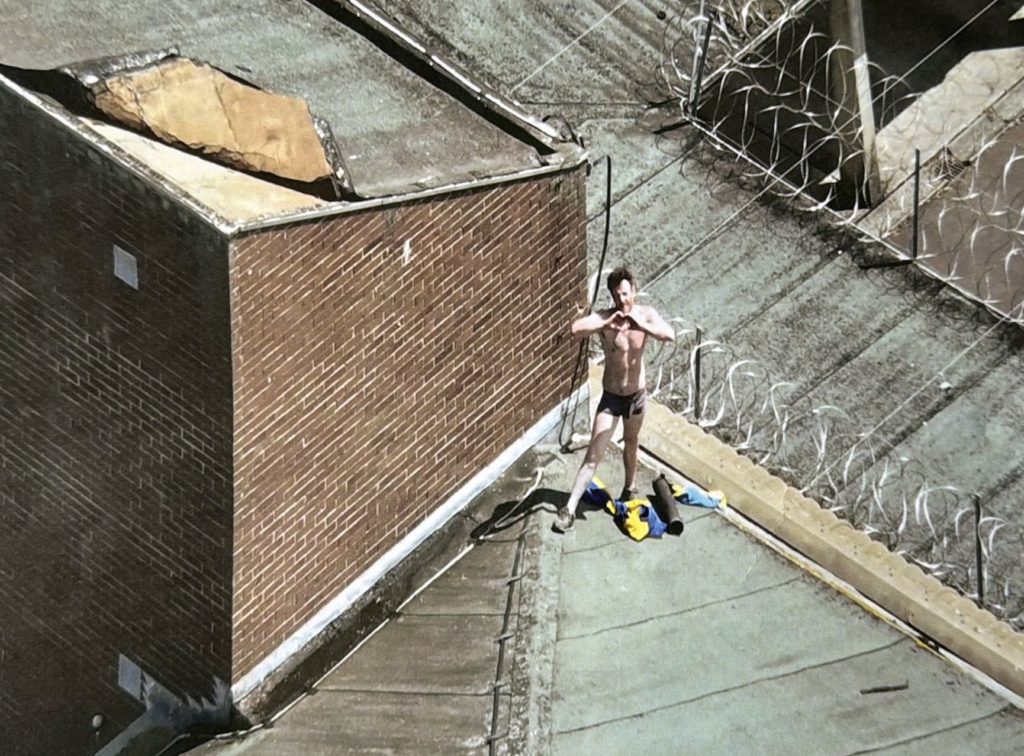
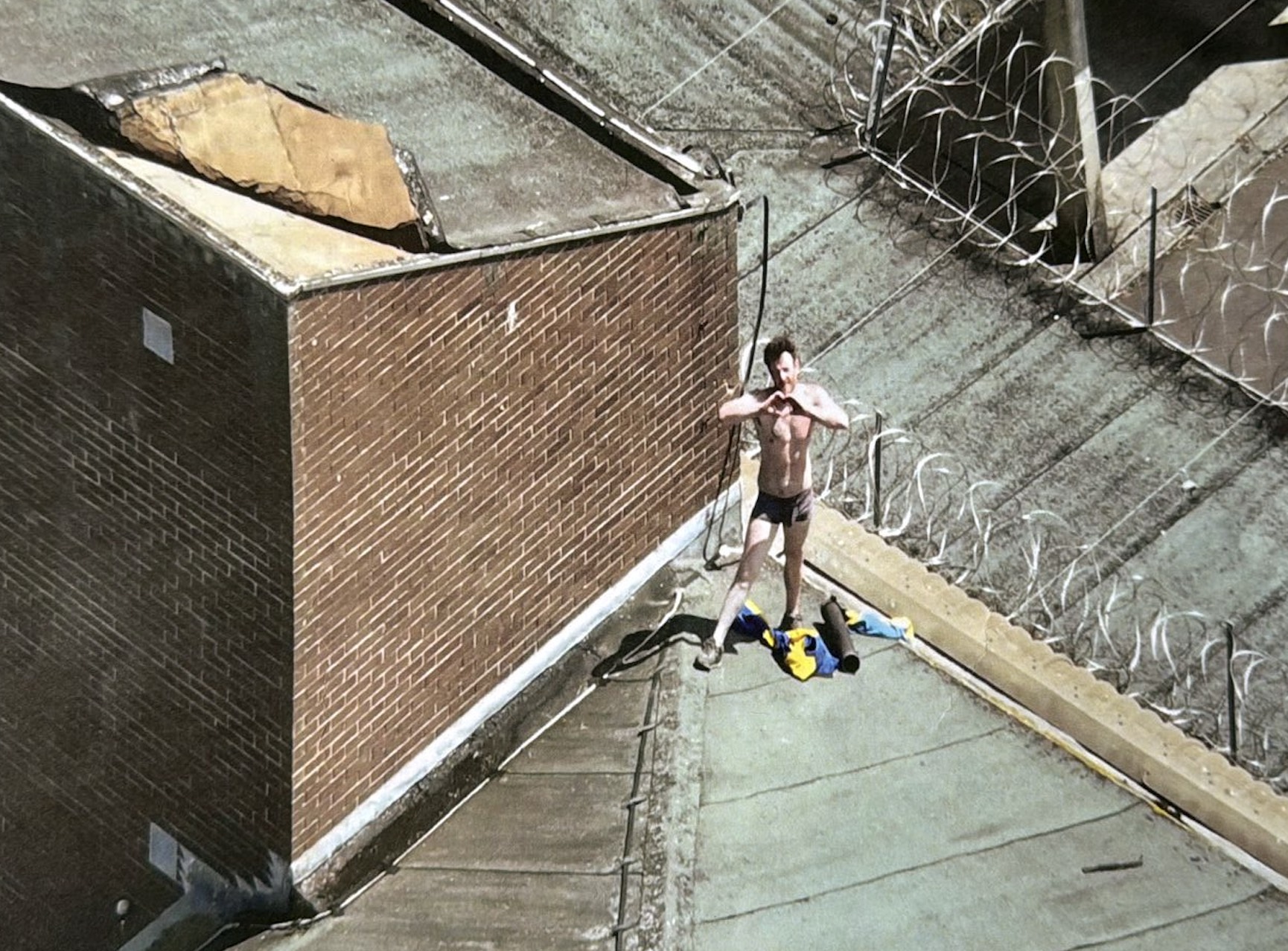
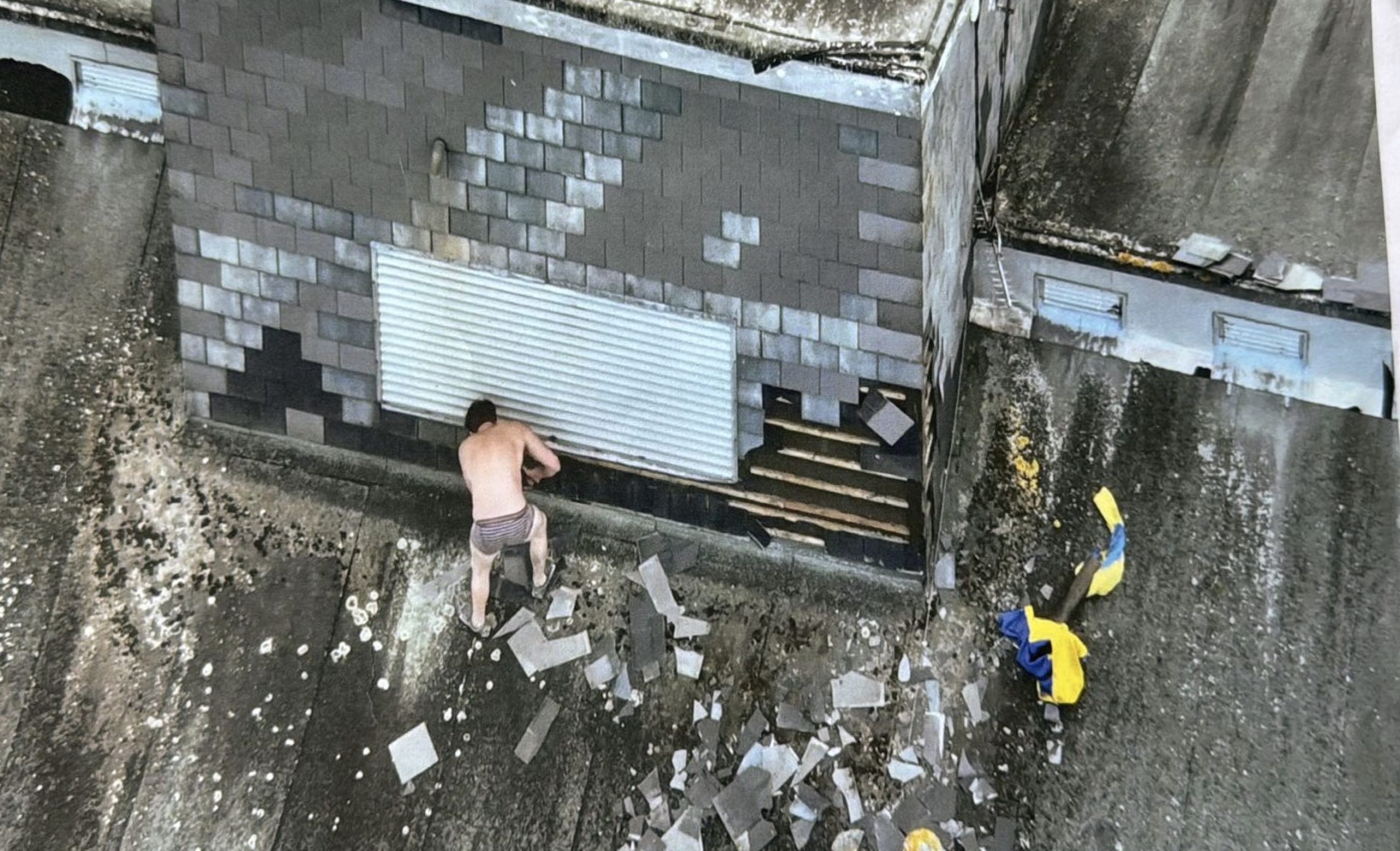
In Court 11 the prosecution begin their case against Outlaw. They set out the 14 counts of criminal damage that occurred while he was held in the high security prison Frankland between May and June 2023. Counts one to 12 are for the extensive damage to Outlaw’s cell. Counts 13 and 14 relate to Outlaw climbing onto the roof whilst protesting his sentence and writing ‘FREE IPPZ’ on the roof whilst in his underpants. The prosecution case is swift, with no witnesses called. They tell the jury that Outlaw caused maximum damage and disruption to get what he wanted in prison. They admit: ‘the IPP sentence may be detrimental to him but it doesn’t make it (the damage) right.’ They ask that he be found guilty on all counts.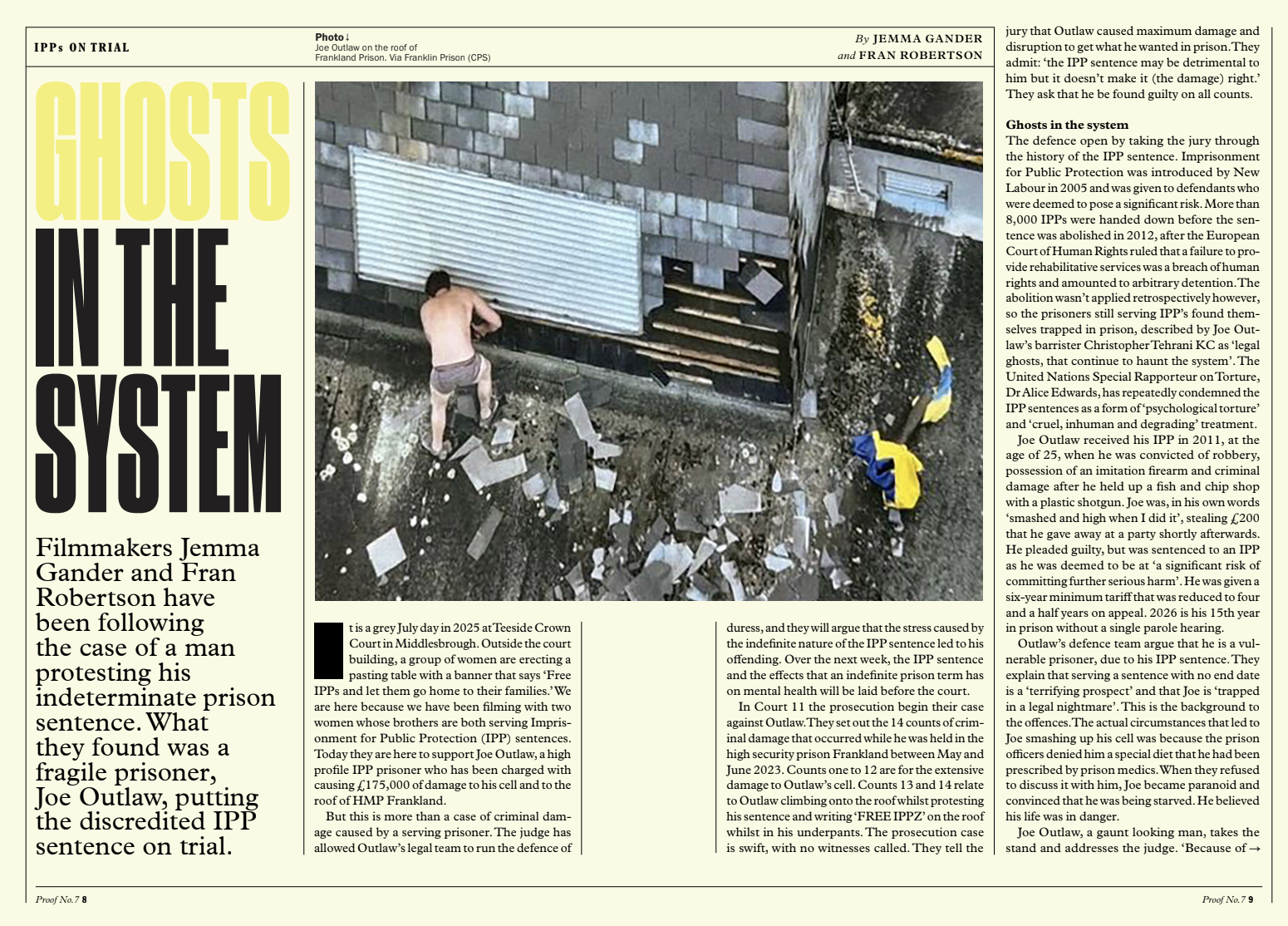
Haunting the system
The defence open by taking the jury through the history of the IPP sentence. Imprisonment for Public Protection was introduced by New Labour in 2005 and was given to defendants who were deemed to pose a significant risk. More than 8,000 IPPs were handed down before the sentence was abolished in 2012, after the European Court of Human Rights ruled that a failure to provide rehabilitative services was a breach of human rights and amounted to arbitrary detention. The abolition wasn’t applied retrospectively however, so the prisoners still serving IPP’s found themselves trapped in prison, described by Joe Outlaw’s barrister Christopher Tehrani KC as ‘legal ghosts, that continue to haunt the system’. The United Nations Special Rapporteur on Torture, Dr Alice Edwards, has repeatedly condemned the IPP sentences as a form of ‘psychological torture’ and ‘cruel, inhuman and degrading’ treatment.
Joe Outlaw received his IPP in 2011, at the age of 25, when he was convicted of robbery, possession of an imitation firearm and criminal damage after he held up a fish and chip shop with a plastic shotgun. Joe was, in his own words ‘smashed and high when I did it’, stealing £200 that he gave away at a party shortly afterwards. He pleaded guilty, but was sentenced to an IPP as he was deemed to be at ‘a significant risk of committing further serious harm’. He was given a six-year minimum tariff that was reduced to four and a half years on appeal. 2026 is his 15th year in prison without a single parole hearing.
Outlaw’s defence team argue that he is a vulnerable prisoner, due to his IPP sentence. They explain that serving a sentence with no end date is a ‘terrifying prospect’ and that Joe is ‘trapped in a legal nightmare’. This is the background to the offences. The actual circumstances that led to Joe smashing up his cell was because the prison officers denied him a special diet that he had been prescribed by prison medics. When they refused to discuss it with him, Joe became paranoid and convinced that he was being starved. He believed his life was in danger.
Joe Outlaw, a gaunt looking man, takes the stand and addresses the judge. ‘Because of my ADHD, apologies if I’m a bit fidgety,’ he says. Outlaw is 39 years old. The jury hear that he was taken into care as a child and lived in 30 different homes, moving on average over twice a year. He has been diagnosed with OCD and with ADHD, scoring 17 out of 18 at his assessment.
His testimony is harrowing. When asked about whether he has self-harmed, he says ‘embarrassingly I have. Many times. There are moments of cutting. Some people give themselves chicken cuts because it’s cathartic. I get broken and I chop myself and cut myself very deeply, very severe. And (I’ve) taken overdoses – four or five times – when in a moment I’m so alone and down. It’s not easy to kill yourself so I’ve tried smoking myself out of my cell. I wasn’t successful.’ There is silence in the court as Joe says: ‘No one gives a shit about me.’
Outlaw is one of almost 2,500 IPPs still in prison, caught up in a deadly vicious cycle. Here’s the Catch 22.
Thirteen years after the abolition of the sentence the onus is still on these IPP’s to prove to the parole board that they are safe to be released. But the nature of the sentence has been shown to cause acute anxiety, psychosis and paranoia, leading to behaviour that is erratic and problematic. This means that the parole board continues to judge them a risk. So, they remain in prison, unable to access the mental health care that they need, held for months and sometimes years in segregation in conditions that are inhumane and degrading. Which inevitably leads to more mental deterioration and further disruptive behaviour.
Outlaw says that he ‘lost hope about four years in when I started to see the sentence for what it was and it just got worse from then’. It was at that time that he started causing criminal damage to fixtures and fittings in his cell – a long list of smashed basins, windows and bedframes. Since the start of his sentence, Outlaw has been to 43 prisons and spent around six years in segregation units. He has already been sentenced to a further eight years and eight months in prison for previous criminal damage whilst serving his IPP. He pleaded guilty to all charges until today. He says this time is different, that when he was in Frankland and mistreated by officers, he feared for his life.
 The defence calls Craig Nethercote, a recently retired deputy prison governor with 32 years experience of working in prisons. He describes Joe as ‘likeable’ and ‘pro staff’. He tells the court how Joe would walk on his hands to the exercise yard. Nethercote recognised that Joe would cause damage when he became frustrated, so he arranged for Joe to have guitar lessons which helped him regulate. It was through Joe that Nethercote became aware of the effects of IPP and how the uncertainty impacted. ‘I could see it,’ he says, ‘his emotions were so close to the surface.’
Rain lashes at the windows of the court. Inside, it has felt as if both a man and the IPP sentence have been on trial. The writing on the banners outside tell us that more than 90 IPP prisoners have taken their own lives, while the legal teams inside relate the increase in self-harm amongst inmates serving the sentence. When the jury retires, we wonder how much they have been able to empathise with a convicted criminal, whose life experience and situation is so different from their own.
After two hours and 40 minutes the jury returns, confirming they have reached a verdict on counts 13 and 14 but not counts 1 to 12. They find Outlaw guilty for the roof escape. The judge requests they retire and return with a majority verdict on the other counts. Three hours later the twelve men and women file back into court to deliver their final verdicts. Joe Outlaw is found not guilty for the damage to his cells on counts 1-12. There is an audible sigh of relief from his supporters. Joe is sentenced to a further three years to be served concurrently with his IPP.
Outside, Joe’s barrister Jamie Adams KC tells us the importance of arguing Joe’s case as it has ‘brought to the public’s attention the iniquitous nature of the IPP sentence’ and that ‘it’s not right, in a civilised society like ours that the government can’t figure out a way of re-sentencing those people and enable them to move into the community’. He hopes Joe will be able to work towards release and rebuilding his life.
In September 2025 a landmark complaint was filed with the UN. They will investigate whether Britain is still breaching human rights law by arbitrarily detaining IPP prisoners. A resentencing bill has been shelved in the Lords but the campaigners continue to fight to free those serving IPPs.
It seems to us that the jury understood that this man – although flawed – was driven to extreme behaviour by a myriad of severe mental health conditions and the uncertainty of never knowing if he will be released from prison. They believed he was acting under duress. The jury appeared to understand the environment and the impact this sentence had on Joe and the other IPP inmates still in prison. Now it’s time the government did too.
Back outside court, we film Joe’s supporters as they pack up their t-shirts and banners, heading home knowing they will need them again soon.
Joe is now at HMP Holme House where he is hoping to achieve his Cat D. Joe is mentoring on his wing and is very pleased to share his cell with a pet budgie called GG.