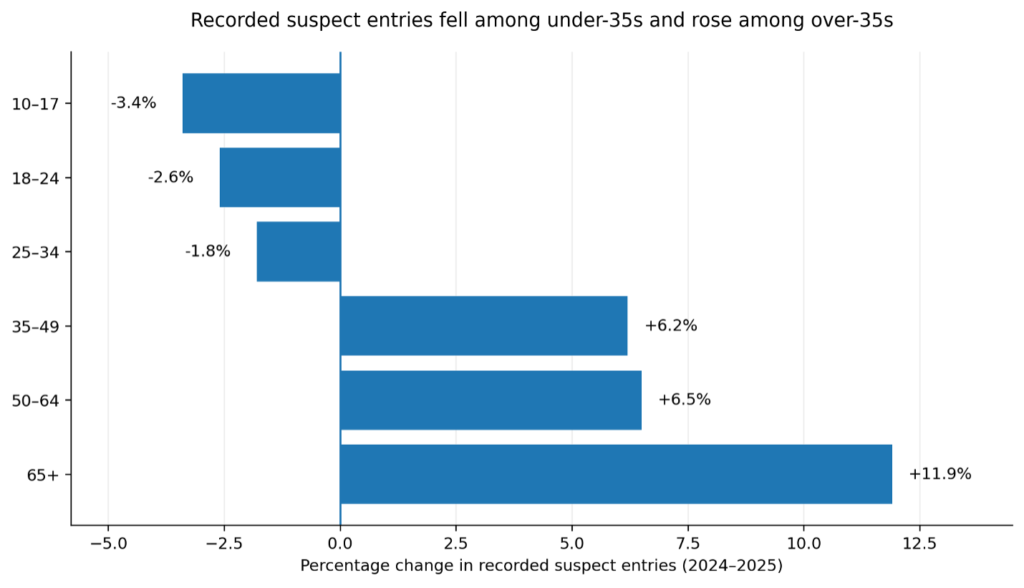

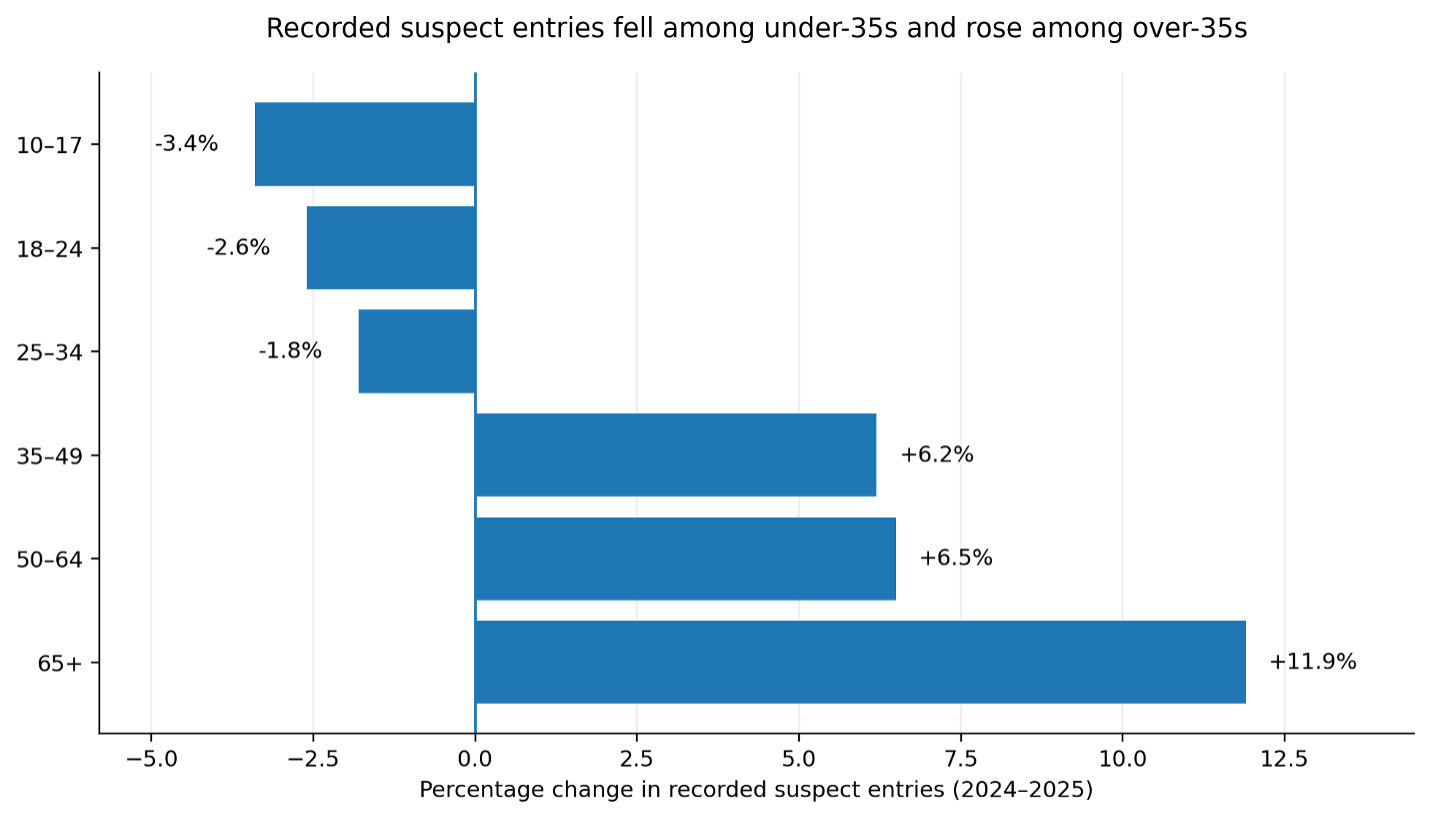
Police records of crime suspects increased among people aged 35 and over between 2024 and 2025, while falling across every age group under 35, according to research by Manak Solicitors using data obtained from police forces through Freedom of Information requests.
The largest percentage increase was among people aged 65 and over, with recorded suspect entries rising by 11.9 per cent. Entries involving people aged 35-49 rose by 6.2 per cent, while those for people aged 50-64 increased by 6.5 per cent. By contrast, entries involving 10-17-year-olds fell by 3.4 per cent. The number involving 18-24-year-olds fell by 2.6 per cent, while those for 25-34-year-olds dropped by 1.8 per cent.
Across the six age groups, the total number of recorded suspect entries rose from 905,343 in 2024 to 923,966 in 2025, an increase of about 2.1 per cent. People aged 35-49 accounted for the largest number of entries in 2025, with 319,295 records, up by 18,525 on the previous year.
Table: Recorded suspect entries by age group, 2024-2025.
| Age group | 2024 | 2025 | Percentage change |
| 10-17 | 83,743 | 80,928 | −3.4% |
| 18-24 | 138,320 | 134,657 | −2.6% |
| 25-34 | 239,140 | 234,793 | −1.8% |
| 35-49 | 300,770 | 319,295 | +6.2% |
| 50-64 | 113,647 | 121,028 | +6.5% |
| 65+ | 29,723 | 33,265 | +11.9% |
| Total | 905,343 | 923,966 | +2.1% |
Source: Manak Solicitors’ analysis of police data obtained through Freedom of Information requests.
The figures represent recorded suspect entries, not necessarily unique individuals, charges or convictions. They do not establish how many people in each age group were convicted of an offence.
Violence against the person was the most commonly recorded offence across all age groups, according to the analysis. It accounted for between 45.5 per cent and 64.1 per cent of records for which an age and specific offence category were available.
| Age group | Most common offence | Second | Third |
| 10-17 | Violence against the person | Arson and criminal damage | Sexual offences |
| 18-24 | Violence against the person | Drug offences | Theft |
| 25-34 | Violence against the person | Theft | Drug offences |
| 35-49 | Violence against the person | Theft | Public order offences |
| 50-64 | Violence against the person | Public order offences | Theft |
| 65+ | Violence against the person | Public order offences | Sexual offences |
Source: Manak Solicitors’ analysis of police data obtained through Freedom of Information requests.
The second most common categories differed by age. Arson and criminal damage ranked second among 10-17-year-olds, while drug offences ranked second among 18-24-year-olds. Theft was the second most common category for those aged 25-34 and 35-49. Among people aged 50 and over, public order offences ranked second.
People aged 35-49 formed the largest suspect group in 10 of the 11 crime categories examined. Drug offences were the exception, with 18-24-year-olds accounting for the highest number of recorded suspect entries.
Manak Solicitors also compared the figures with population estimates for the police-force areas where matching data was available. On this measure, people aged 25-34 had the highest estimated rate, at 50.04 recorded suspect entries per 1,000 people per year. The rate was 48.09 among 35-49-year-olds and 47.95 among those aged 18-24.
The estimated rate fell to 18.8 per 1,000 people among those aged 50–64 and 5.2 among people aged 65 and over. For 10-17-year-olds, the rate was 25.85.
The population-adjusted figures therefore show that younger adults continued to have higher estimated rates of recorded suspect entries than older age groups, despite the increase in entries involving people aged 35 and over.
Samir Moftah, director and solicitor at Manak Solicitors, said crime and antisocial behaviour were often discussed as problems predominantly involving teenagers and young adults.
‘While younger adults still have some of the highest suspect rates relative to their population, these figures show that the recent direction of travel is very different from that popular perception,’ he said.
The findings are based on responses to Freedom of Information requests. Comparisons may be affected by differences in police recording practices and the availability of data across forces.