
Six indeterminate sentences known as IPPs have been overturned by the Court of Appeal and the miscarriage of justice watchdog is reviewing a further 150 cases. Of the six, three – Benjamin Hibbert, Stuart O’Neill and Jay Davis – were all convicted as young men more than 15 years ago and have remained in custody since then, despite none having been given a tariff of more than three and a half years. The Court of Appeal also quashed the sentences of Jerry Tolbert, Jordan Webster and Dawayne McLaren.
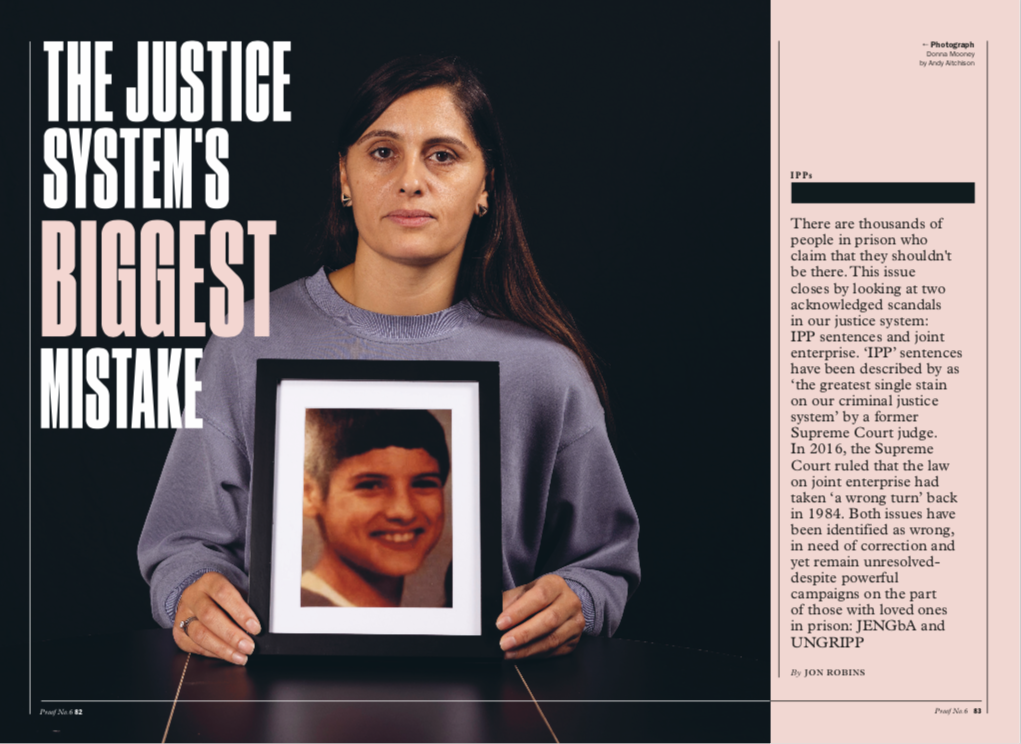
The controversial IPP (Imprisonment for Public Protection) sentence was introduced by New Labour’s Criminal Justice Act 2003 and was described as a ‘legislative statement of toughness on crime’ – see below. The campaign group UNGRIPP welcomed ruling. ‘While we celebrate the freedom of these individuals—some of whom were sentenced as young adults and have spent decades in limbo—this ruling highlights the systemic failure of a sentence that remains a stain on the British justice system. These cases prove that many original IPP sentences were not only disproportionate but legally flawed.
Despite being abolished in 2012, over 2,700 people remain subject to IPP sentences. ‘This recent success in the Court of Appeal must act as a catalyst for the Government to take decisive action. We call for an immediate review of all IPP cases involving those sentenced as young adults and a commitment to ending the trauma of indeterminate detention for good.’
Three of the cases were referred by the Criminal Cases Review Commission (CCRC). ‘I welcome the Court of Appeal’s decision in all these cases,’ said CCRC Chair Dame Vera Baird. ‘The decision to refer three of these men’s sentences followed careful and detailed reviews by the Commission. All the men were very young at the time they were sentenced and have spent many years beyond their original tariffs in custody. The Court’s judgments reflect the importance of properly considering age and maturity when imposing sentences of this nature.’
Baird continued: ‘We will continue to examine other IPP and DPP cases, and I encourage anyone who believes their sentence may have been affected—and who has exhausted their appeal rights—to apply to the Commission. I hope today’s decision gives hope to the many families with loved ones who remain in prison way beyond their original tariff.’
The CCRC is currently looking at more than 150 IPP/ DPP cases, the latter (Detention for Public Protection) sentences were the similar indeterminate sentences imposed on people aged under 18 who were considered dangerous. Both types of sentences were abolished in 2012. New sentences were substituted for the quashed IPP/ DPP sentences. Davis received a sentence of 18 months imprisonment, O’Neill an extended sentence with a custodial element of eight years and licence of eight years, Webster an extended sentence with a custodial element of five years and licence of eight, McLaren an extended sentence with a custodial element of seven years a licence of five years, and Tolbert a sentence of five years.
The CCRC’s reviews in these cases found ‘a real possibility that the Court would find that sentencing judges had failed to attach the necessary weight to the age and maturity of the offender before imposing an indeterminate sentence’. The referrals arose from work carried out by the CCRC to examine the implications for other IPP/DPP cases arising from the Court’s decision in the cases of Leighton Williams [2024], Darren Hilling [2024], and Steven Sillitto [2025] who were young adults when they were sentenced (as reported here: https://www.thejusticegap.com/appeal-judges-to-revisit-controversial-ipps-following-five-new-ccrc-referrals/).
IPPs: a disaster foretold
IPPs were fiercely opposed by the judiciary and prisoners’ rights campaigns when it was proposed by the then Home Secretary David Blunkett. Lord Woolf, then the Lord Chief Justice, recalled his efforts to dissuade the minister. ‘But I obviously failed and we see now the consequences of the biggest mistake made in the criminal justice system during my period as a judge.’
Almost immediately the IPP proved problematic. In her annual 2007 report, the prisons inspector, Dame Anne Owers, noted that its planning and introduction had been ‘badly mismanaged’ and had imposed ‘a needlessly large burden on prison budgets’, forcing prisoners to navigate their way through a system of (again) ‘Kafkaesque complexity’. ‘The bureaucratic treacle in which prison … staff in general found themselves struggling was another legacy of this politically motivated law,’ she noted.
While the Home Office initially estimated that the introduction of IPP sentences would result in the imprisonment of some 900 people, more than 8,000 IPP sentences have been imposed.
Blunkett has since owned his ‘culpability’ and admitted the original intention to provide adequate support to both provide safety for the public and for rehabilitation had gone ‘badly wrong’. The sentence was abolished in 2012 – but that abolition was not retrospective – see here for a history: IPPs: a disaster foretold.’