Since the Home Office launched a consultation on ‘The Future of the Undercover Policing Inquiry’ this summer (see my story in Private Eye 1681, p. 38), it has been uncertain whether the statutory public inquiry, currently chaired by Sir John Mitting, will be allowed to conclude its work.
Last month, the Inquiry finished its final day of open, oral evidence on the Special Demonstration Squad (SDS), a secret unit of the Met’s Special Branch that spied on political groups from 1968 to 2008. The Inquiry heard from two witnesses, a former undercover officer known as HN60 (cover name ‘Dave Evans’), who spied on London Animal Action and the Socialist Workers’ Party from 1998 to 2005 (see my story in Private Eye 1685, p. 40), and Helen Steel, an activist and former McLibel trial defendant who was deceived into a sexual relationship by former undercover officer John Dines for two years. In the course of Steel’s evidence, it was revealed that the Met had a full understanding of the scale of sexual abuse committed by undercover cops by the time of the announcement of the public inquiry by then Home Secretary Theresa May.
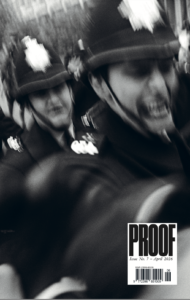
- You can read Kate Wilson of Police Spies of Our Lives in the latest issue of PROOF: Cover-ups, jailhouse snitches and scapegoats – plus
- Peter McNamara on ‘A very British Stasi’ and the ‘creaking’ progress of the inquiry
 An internal report, likely written between July 2014 and November 2015, outlined the reputational and litigation risk to the Met, which it had examined in response to legal action brought by Steel and other deceived women. The document acknowledged that undercover officers engaged in relationships to bolster their cover and ‘for their own gratification’, at the time identifying 24 allegations of sexual relationships against 19 undercover officers (the UCPI has identified a further 7 undercover officers who engaged in sexual relationships), acknowledging that such misconduct was an overall corporate failing on the part of the Met that was ‘appropriate and capable of proof’. According to Police Spies Out of Lives, a campaigning group representing women who were deceived by undercover cops, at least 60 women were tricked into relationships by Metropolitan Police spies.
The document also revealed that Operation Herne, the Met’s investigation into the SDS, continued to publicly adhere to the policy of Neither Confirm, Nor Deny (NCND) for undercovers who had neither outed themselves nor been confirmed as such by public bodies, also electing not to tell victims that their former partner had been a spy. The report stated, ‘there are several possible “victims” who have either had sexual relationships or been identified as possibly having sexual relationships with undercover officers without being aware’ (quotation marks appear in original). Rather than disclosing this information to those affected, the Met left it up to the Inquiry to investigate further what the Met itself already knew 11 years ago, and resisted the public disclosure of significant quantities of documentation, all at a cost to the taxpayer of £145m. The document concluded ‘The question for the MPS is quite simple; how will the current stance be viewed in the public arena?’.
New evidence relating to sexual deception by undercover officers is still emerging long after the Inquiry began hearing evidence in 2020. Steel told the Inquiry that information relating to a sexual relationship between HN60 and a woman known to the Inquiry as ‘Olivia’ had only been disclosed to her after a member of the public saw Steel give evidence to the Inquiry in 2024. After knowledge of this relationship was disclosed to the Inquiry, HN60 was compelled to give open, oral evidence, albeit with the privilege of anonymity. HN60 had previously lied to both Operation Herne in 2013 and the Inquiry in 2022 when he submitted an initial witness statement denying that he had engaged in any sexual relationships during his deployment. When he finally admitted a relationship with ‘Olivia’ in a second witness statement served in July of this year, HN60 only admitted a relationship of approximately six months. In oral evidence, he accepted that independent evidence showed he was in a relationship with ‘Olivia’ for at least two years from 1998 to 2000. Despite previous assurances from Mitting that officers who engaged in sexual relationships would not be granted anonymity, HN60’s real name will not be published. Mitting declined to reverse this decision in light of written submissions that followed HN60’s oral evidence. In a ruling published last week, he said that ‘I would have been prepared to reconsider if any of the three women affected – “Olivia” and his first and second wives – had wished me to do so. The Inquiry has been in touch with them and has received no such request.’
The Met settled the claims brought by Steel and six other women and publicly apologised for the relationships in November 2015, paying all seven women substantial compensation. However, when it was deciding whether or not to settle these claims, the Met continued to pursue an aggressive legal strategy, seeking to maintain NCND at the Inquiry until 2016 and refusing to provide any material witnesses of fact or to cross examine opposing witnesses in Kate Wilson’s successful claim against it in the Investigatory Powers Tribunal (IPT). The Met’s only explanation for the latter was that witnesses to the IPT had no expectation of immunity from prosecution. Thanks to a 2016 undertaking by the then Attorney General, Jeremy Wright KC, witnesses to the public inquiry will not be prosecuted as a result of any evidence they give nor can their evidence be used in criminal prosecutions, exception where they have lied to or conspired to lie to the Inquiry.
Campaigners argue that the Met’s primary interest remains reputation management. Police Spies Out of Lives said in response to this evidence that ‘the Met has repeatedly delayed the disclosure of key documents, redacted material far beyond what is necessary (even redacting material already in the public domain), and forcing endless additional wrangling over evidence that the MPS has had in its possession for years. All of this is quite apart from the documents that were destroyed well after the UCPI was announced. This pattern suggests an organisation more concerned with shielding its reputation, and that of the officers involved, than with allowing victims of undercover policing to finally learn the truth about what was done to them’.
Closed hearings will continue throughout the autumn, and Mitting is expected to publish his second interim report on the SDS sometime in 2027. The Home Office is yet to take a decision on the consultation launched in the summer. An internal report arising from that consultation will be produced towards the end of the year, on which the Home Secretary is expected to make a decision early next year.
Buy PROOF, support the Justice Gap