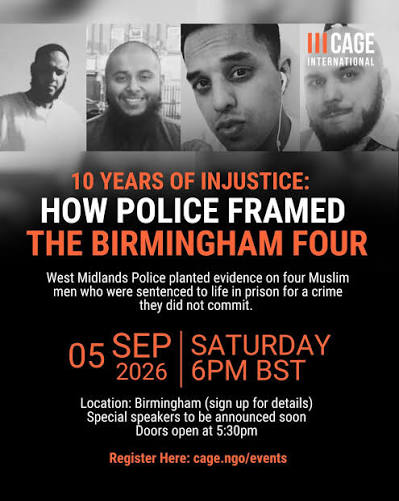


One of the four Muslim men known collectively as the Birmingham Four who claimed to have been fitted up by an undercover policing operation addressed a meeting convened to mark the 10 year anniversary of their conviction. Khobaib Hussain told supporters that he and his fellow co-defendants would ‘never lose hope. We continue to fight for justice to be done.’ Jon Robins reports
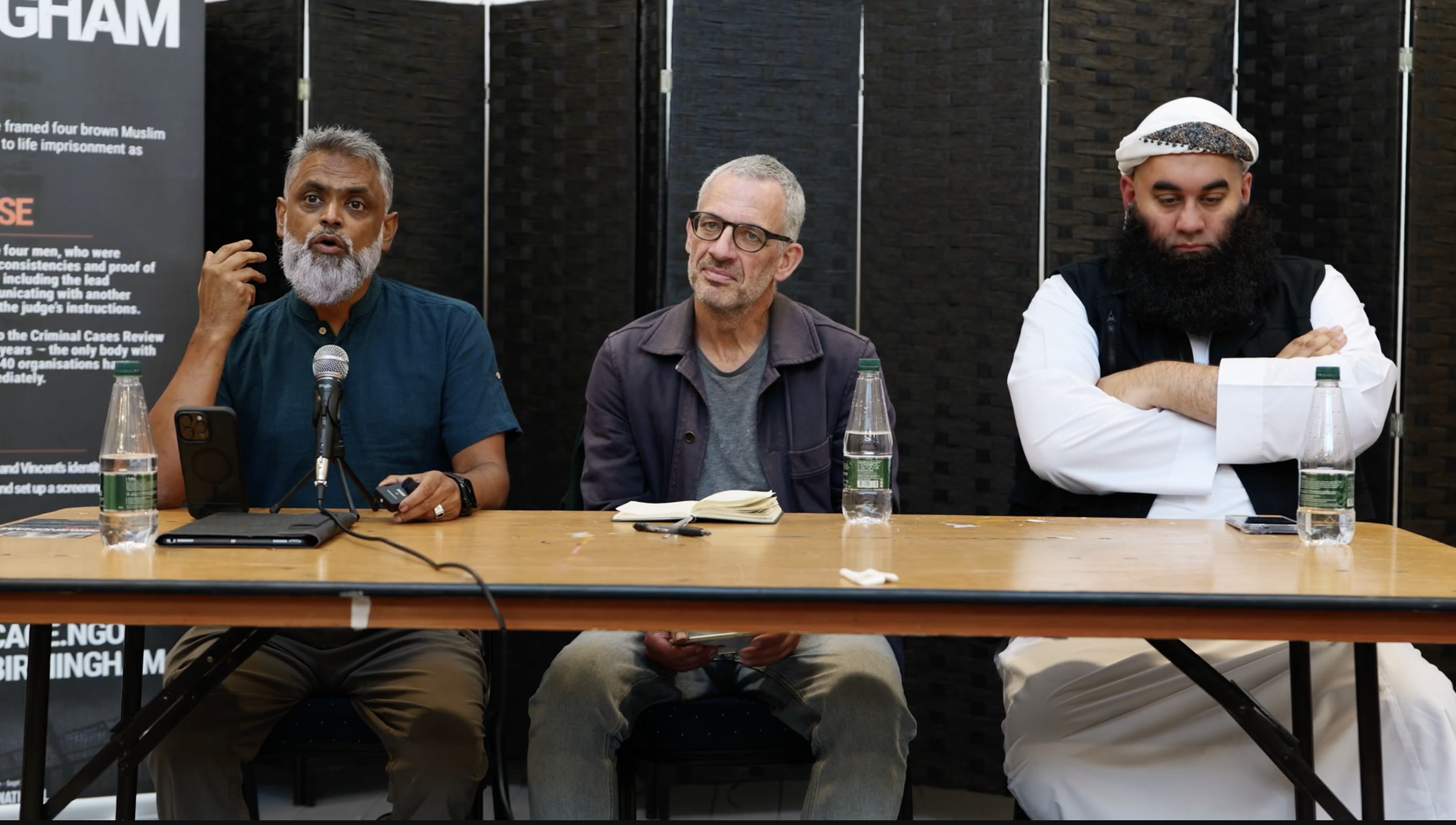
L to R: Moazzam Begg, Tim Crosland and Maulana Sikander
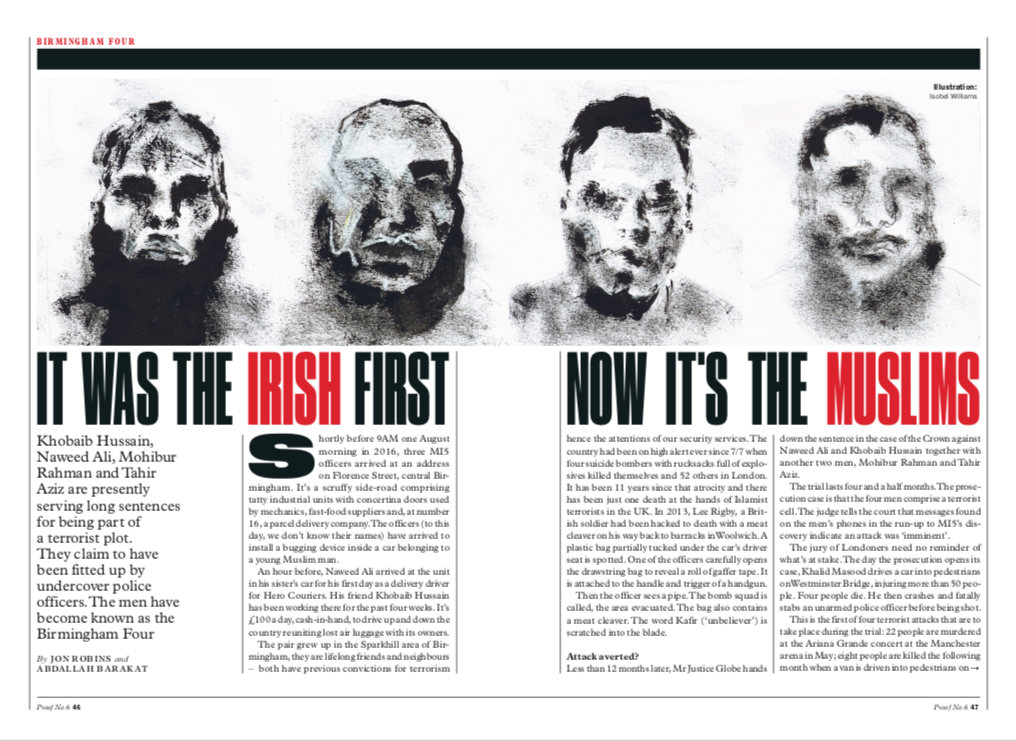
It has been 10 years since Khobaib Hussain together with his friend and neighbour Naweed Ali, Mohibur Rahman and Tahir Aziz were imprisoned for life sentences with minimum terms of 20 years and 15 for Aziz. The prosecution case had been that the four men comprised a terrorist cell which was about to strike. The men have always protested their innocence, claiming that a terrorist ‘kill kit’ was planted in the car that one of the men was driving and that the corruption of the undercover police officers was comprehensively exposed during the trial.
Khobaib Hussain, currently in HMP Belmarsh, joined the meeting in Birmingham by phone. ‘The system is designed to mentally break you,’ he told supporters. ‘It keeps you on a merry-go-round in pursuit of false justice. The institutional corruption from the police to the court to the prison enable state-sponsored terrorism. The real victims here are me and my co-defendants and the families who are being traumatized and terrorize by criminal corrupt police officers.’
The 10 year anniversary of their conviction was marked in parliament this week with an early day motion proposed by Kim Johnson MP, chair of the All-Party Parliamentary Group on Miscarriages of Justice. The MP who has met with some of the men and their families noted they ‘maintain their innocence and that their legal representatives have raised serious concerns about the conduct of undercover officers, the alleged fabrication and planting of evidence, and the disclosure and handling of evidence during the investigation and trial, with their case now resting with the CCRC’.
Johnson expressed concern that that the men have now spent ten years in prison while these allegations remain unresolved and urged the CCRC to ‘reach a prompt determination on the application concerning the convictions’.
- You can read about the Birmingham Four on the Justice Gap here and in PROOF magazine issue 6
- The event was organised by CAGE. Find out how to support the four men on their resource page here
Last month’s event was organised by Moazzam Begg of CAGE International and panellists included Defend Our Juries co-founder Tim Crosland, a sister of one of the prisoners Mariam Husain, and a local cleric Maulana Sikander.
‘When people talk about miscarriages of justice, what they mean is there’s some doubt about the conviction,’ Crossland said. ‘But the case of the Birmingham Four is not a case where there’s doubt about their convictions. It’s a case where there’s no doubt about their innocence. Anyone who reads the details of that case knows beyond any doubt the Birmingham Four are innocent, and they’ve been jailed for life, and they’ve been in jail now for more than 10 years.’
An undercover unit of West Midlands Police had set up a fake courier company with the sole purpose of employing Hussain in the hope he would incriminate himself as he chatted to co-conspirators running fabricated errands. Hussain and Ali had terrorism convictions for travelling to Pakistan to attend a training camp. They came back within two days when their families discovered where they were.
After four weeks of surveillance, the undercover police had nothing on Hussain and so recruited his friend Naweed Ali. On his first day of ‘work’, MI5 arrived to arrange the surveillance of his car and a plastic bag was discovered containing a partially made pipe bomb, a machete and a gun. The four men say that the bag was planted by undercover officers immediately prior to MI5 arriving. Ali had handed the car keys to one of the undercover officers, known as ‘Vincent’, so that he could park it within the unit.
It’s now been more than two years that the miscarriage of justice watchdog, the Criminal Cases Review Commission received an application. Hussain and Ali’s solicitor, the veteran human rights lawyer Gareth Peirce has repeatedly compared to the case to her most famous clients, the Birmingham Six. The day after the four men were convicted, Peirce did something she had never done before and published a statement on her website declaring her belief in their innocence beginning: ‘We register our unqualified respect for the system we have of trial by jury in this country. But jurors can on occasion get things wrong.’ ‘This case rests on police fabrication and mendacity in the clearest way,’ she said.
At this month’s meeting, Tim Crosland set out the facts of the case. The Guardian recently described the lawyer who set up Defend our Juries as ‘a radical activist using street protest to challenge the will of the state‘ who had been on a ‘personal “gamekeeper turned poacher” journey’ taking him from being a barrister holding senior positions at the Serious Organised Crime Agency and National Crime Agency to being arrested under the Terrorism Act. He told the newsaper of his ‘duty to intervene’ whether its climate activists or those campaigning against Israel’s actions in Gaza.
One of the shocking features of the case is that the prosecution was forced to release a 38-page phone log of the texts between the undercover officers. More than a thousand supposedly ‘deleted’ texts were recovered going back to Khobaib Hussain’s recruitment a month prior to the raid. The document appears to undermine the integrity of the undercover operation as well as the credibility of the prosecution case.
‘So how is it possible that when the jury and the judge knew the police were lying that we end up with convictions?’ the co-founder of Defend our Juries asked. ‘Well, sometimes the jury system works well because what jurors can do – 12 randomly selected members of thepublic – is that they can bring the outside into that weird, stuffy world of the courtroom. Sometimes that’s a good thing.’ For example, he said when judges have been banning members of Palestine Action from highlighting genocide in Gaza or Israeli weapons manufacturer Elbit systems when ‘judges have more or less been directing the jury to convict Palestine Action’.
But, Crosland argued ‘it could work the other way’. ‘In this trial, people were not convicted by what happened inside court,’ he said, ‘they were convicted by what happened outside court.’ The day the prosecution opened its arguments in the Birmingham Four case, Khalid Masood drive a car into pedestrians on Westminster Bridge. This was the first of four terrorist attacks that took place during the trial including the Ariana Grande concert at the Manchester arena; a van driven into pedestrians on London Bridge; and a van driven into a crowd of Muslims outside Finsbury Park mosque. Crosland claimed one jury member explained that they were late to court by saying: ‘I was on the tube, and I saw somebody reading the Quran, and I thought they must be a terrorist. So I got off the tube.’
‘Those are the circumstances that have led to a situation where four innocent people have been jailed for life,’ he said. ‘And it’s down to anyone who knows those facts and knows the truth to ask themselves what we do about it?’
In January 2025, hundreds of Defend our Juries protectors blocked the strand outside the Royal Courts of Justice hearing ahead of an appeal brought by 16 Just Stop Oil activists. ‘That’s sent a powerful message to the court,’ Crosland said. ‘We will get everybody talking about this case. We will build the political pressure to set the Birmingham Four free.’
The lawyer finished by quoting fellow panellist Maulana Sikander who spoke about the Muslim responsibility to fight for justice. ‘We know that is our duty, because one moment of standing up for justice is worth 60 years of worship.’
Moazzam Begg told the mainly Muslim audience: ‘We grew up when we were a minority in this area, and some of us remember when there were bombings taking place in Birmingham and in Guildford and Harrods and across the country, and it wasn’t Muslims who were accused of it; it was the Irish.’ He explained how he found out about the Birmingham Four case through his own lawyer. The former Guantanamo Bay detainee had been a client of Gareth Peirce for almost a quarter of a century. He recalls when they first met, the solicitor telling him: ‘It was the Irish first and now it’s the turn of the Muslims.’
‘The reason why these police officers got away with what they did is because they had anonymity orders, meaning nobody gets to know who these officers are,’ Begg said. ‘They just hide behind certain pseudonyms or names, Vincent and Haji, and so so forth. We don’t get to know who they were. In the case of the Birmingham Six and the Guildford Four, there was no anonymity order, and so people knew the police officers were, and they could be identified, and that’s what helped to break the case.’
 ‘We have truth on our side’
Khobaib Hussain reflected on the last decade. ‘It’s incredible that you can be minding your own business and be kidnapped from your home and thrown into a police car and told that a bag that has been planted by the police containing a pipe bomb and incriminating items,’ he said. ‘Everything was completely fabricated. This was exposed at the trial. The case is riddled with clear corruption and on every point which the case should’ve been thrown out cases have been thrown out.’
He talked of their lives as category A prisoners ‘constantly told by prison psychologists and probation that we must be addressing our offending behaviour when we did not commit an offence. We are being held hostage to the ransom of admitting guilt to something we did not do. It has been tough at times, especially when I had to watch my grandmother take her last breath through a prison video call. I was not allowed to attend the funeral.’ He pointed out that two of the other men have lost their fathers.
‘But despite that I remain hopeful that something can be done,’ Hussain continued. ‘I hold my head high because we have the truth on our side. The truth always prevails over falsehood… They tried to tarnish our names and failed. Someone once gave the famous analogy – trying to lie in the face of a blatant truth is like trying to extinguish the sun by spitting at it. The truth in this case shines bright expelling the darkness of the treacherous plot of the police. At our times at times I feel such peace and strength within. I know all of this is temporary… No matter what the outcome me and my defendants remain with our integrity intact and hope. We continue to fight for justice to be done.’
‘Along my journey I have met others who are also innocent and remain defiant in the face of injustice – some have already served 23 years and are still fighting. When I see the resolve in other prisoners, I find it inspiring. One can only have such perseverance if one is telling the truth.’ He mentioned Omar Benguit by name. His case has featured extensively on the Justice Gap. Hussain signed off with a quote from Malcolm X: ‘A man who stands for nothing will fall for everything. I urge hear everyone to stand for justice.’
Support the Justice Gap, buy PROOF magazine